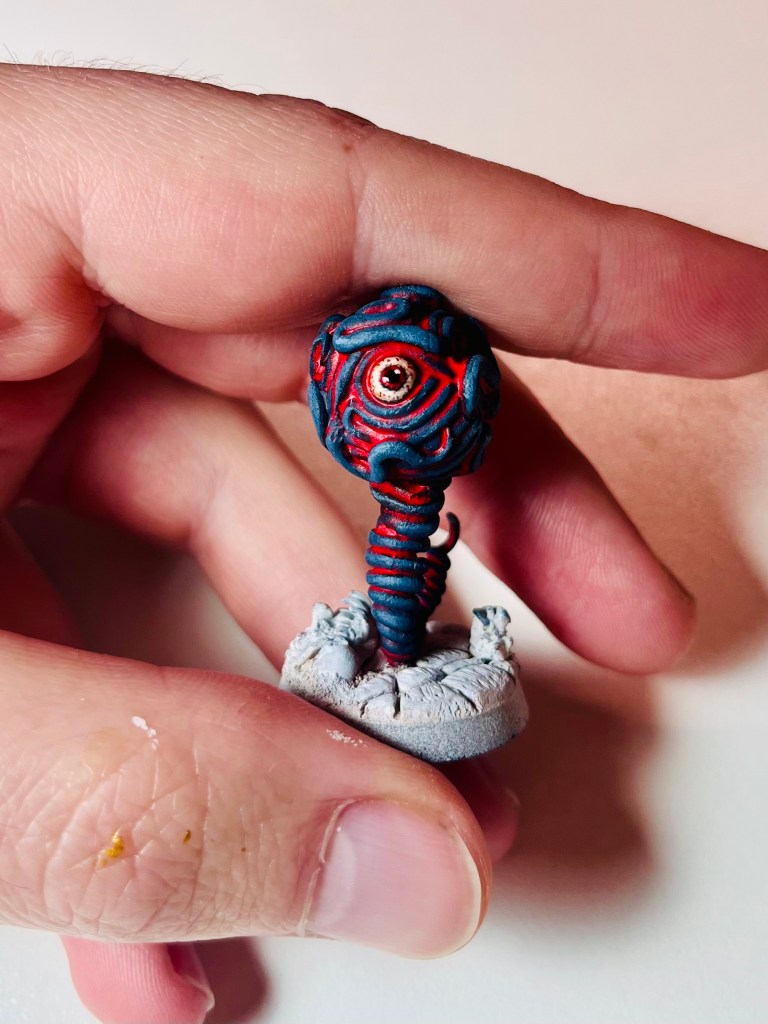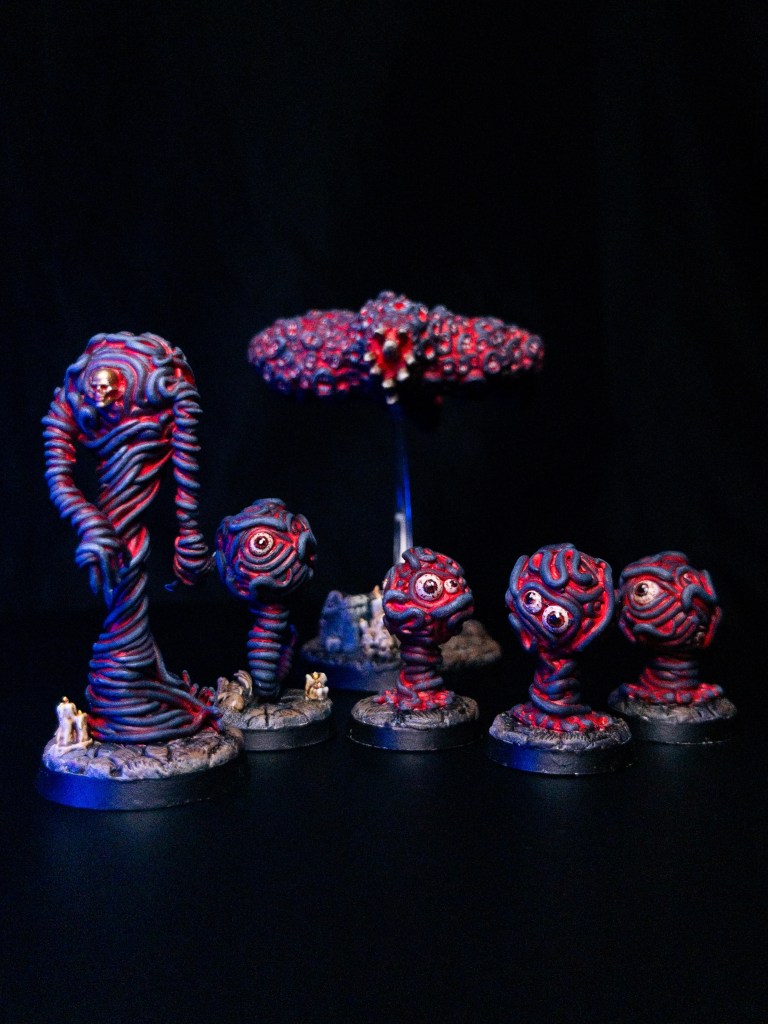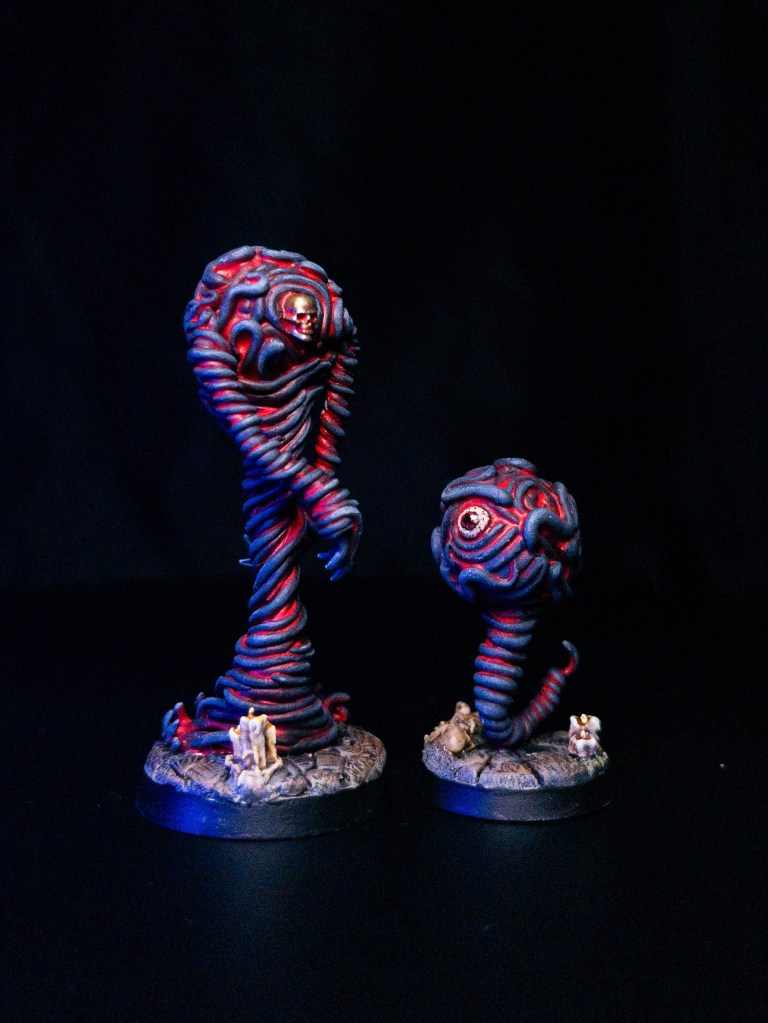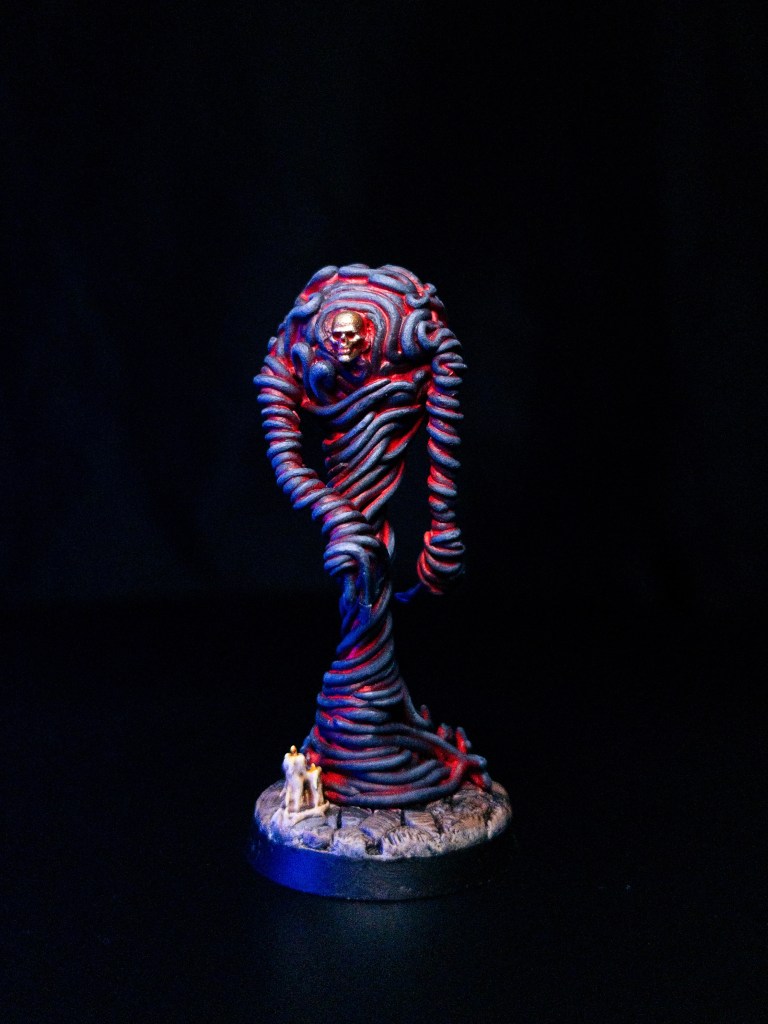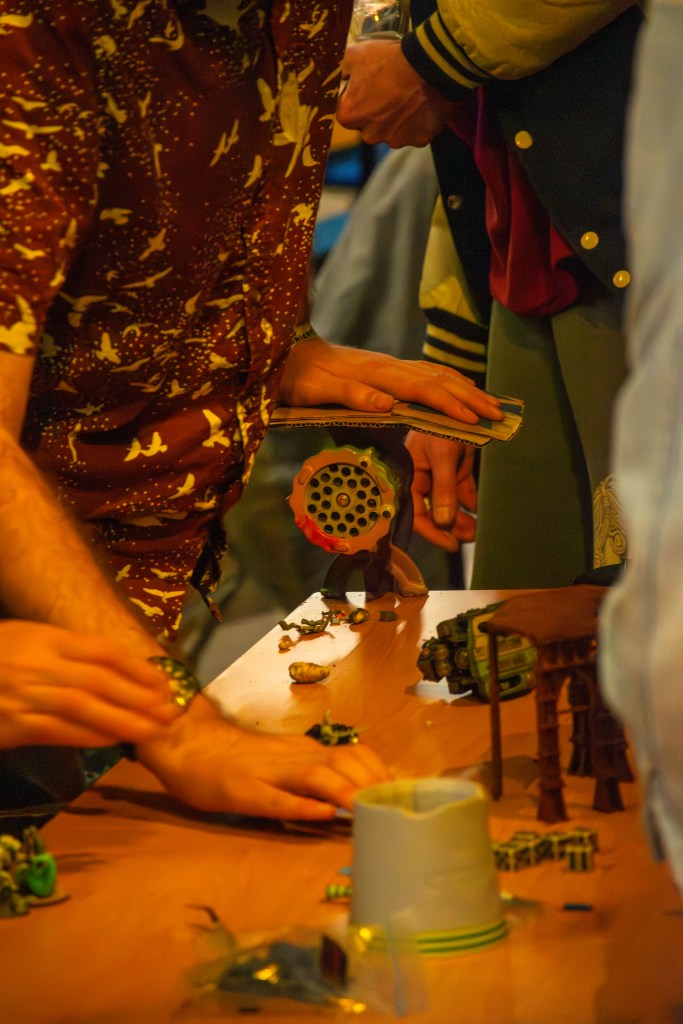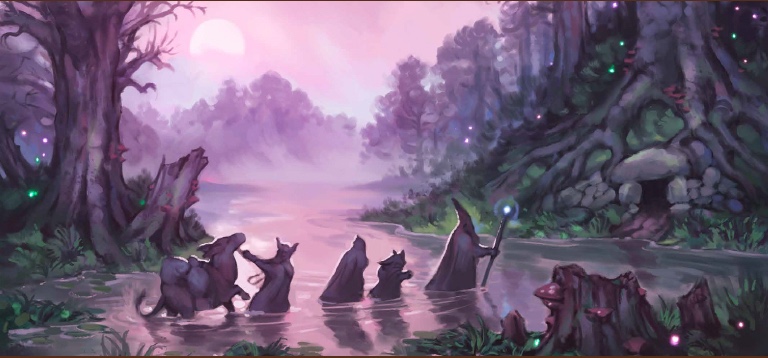
Author: G R O B

  • Chance does not tell stories, characters do

    Escapism, but make it beautiful

    As a long-time Game Master, I’ve always felt that the holy grail for my personal set of skills was the marriage of a completely free-form, aim-less hex crawl with the intentional, arc-building and tension-rising story type of play.

    There is probably some “dungeon-tuber” out there with some strong opinions on that, claiming to have years and years worth of RPG-play to prove their point (spoiler: they haven’t, they’ve probably read some RPG books, at best.). Some old grognard will tell me how this is cheating the principles of old-school-play yadda yadda yadda. I’ve long fallen out of any RPG or OSR-related discourse. System-matters discussions is the last thing I remember. None of it matters.

    What matters is that my players have a grand time, and we create fond and fun memories of our collective hallucinations in fictional fantasy realms.

    Now I know from my own group of friends, for whom I’ve been their forever-GM that they love big, epic stories, slowly unfolding, over months, years even – with surprising twists and turns, a large set of returning NPCs, where some become hated and some loved protagonists in this big, unfolding story. They don’t need to play super-heroes, are fine with character death, but also like to imagine their PCs at the center of world-shifting events. I mean, it’s an escapist hobby, so who doesn’t like to imagine that.

    We have concluded a 6-year long campaign recently, which was very story-focused, very scene-by-scene based and driven by complex, intermingled plot-lines, but at the end of the day, a limitation in choice. The campaign could have ended in one of approximately seven ways, and my players decided in the end for one outcome. It was immensely satisfying concluding their individual and collective story arcs and writing an epilogue for the stories of their respective characters.

    After such a style of play, we switched to something that could be described as the polar opposite. We started playing Dolmenwood this year. Hex-crawl in it’s purest form. I pushed them into this world, with little to no guidance. Only hints about the bigger picture, the factions and their conflicts, etc. – all to be discovered, through random play, rumours and all the other tropes.

    Now from experience, I know that the collective end of the ADHD-spectrum of my playgroup will never uncover all the underlying themes, conflicts, mysteries and factions within this wood full of Dolmen by pure chance, even though they would love to. But the dynamic of play is just too much a meet-up of five late-30s / early 40s guys being silly for 3 hours straight and being unable to stop giggling, doing voices of their whimsical characters and thinking of the craziest shit they could possibly do to derail the homeopathic hint of a GM-plan.

    To let the PCs participate in great story arcs within a hex crawl setting, a GM does not need a rumor table, but really interesting and compelling NPCs. Characters, that will fascinate the players for months and years and attract them through their presence to places and plot points they might otherwise miss.

    Enter stage: the “Glue-NPC”. Yes, this is my very own original name, and if you came up with it before me, then fuck you. Admittedly, I’ve stolen the concept from another famous hex crawl system of recent memory, “Forbidden Lands”, even though it’s not formalised in these books, but it’s an implicit concept within the campaign “Ravens Purge”.

    So what do I call a “Glue-NPC”? In Forbidden Lands it’s an NPC called “Merigall”, and it turns out they are a shapeshifting trickster of unknown origin (at least at the early stages of playing Forbidden Lands). If a campaign lasts long enough PCs would eventually find out Merigall’s history and motivations. But the true, meta-purpose of this character is to interject itself in regular intervals, in different shapes (sometimes as an old man by the fire, sometimes as a woman, sometimes as a child, an animal) and through encounters with the PCs slowly build up a relationship with them that eventually can make Merigall a) an unreliable narrator for the players and b) a shady quest giver and c) a gatekeeper of secrets slowly unfolding. Even though, it turns out, the players might enter into a deal with the devil. But the NPC will keep them glued to the larger narrative that is hidden amongst all those hexes or rumor tables.

    Merigall’s shapeshifting abilities also reveal themselves through piercing, yellow eyes – each form they take is characterised by these piercing yellow eyes, and soon characters would piece one and one together and realise they are interacting with the same type of being or literally the same person in different forms. When played well, this relationship with Merigall becomes an uneasy alliance that eventually can thrust characters into the epicenter of the conflict within the Forbidden Lands and towards some climactic battle – if they wish to pursue it of course.

    In a sandbox type game it always remains the player’s choice, if they will follow such narrative threads or breadcrumbs. But offering them that as a GM is an easy (and honestly also fun) way to do it. I like to play the strange old wizard, the annoying goblin, the ambiguous trickster – I as the GM don’t want to just play the referee between “the world” and my players.

    So, in Dolmenwood I have literally started the campaign in Session 1 by throwing my Glue-NPC at the characters. After 15 minutes of play a Grimalkin introduced himself, shapeshifting from a cat sleeping on a windowsill in the obligatory tavern where they met, and putting the characters before a tricky choice of following the opening adventure for their own purpose, or if they would return the treasure to my trickster-ish cat shapeshifter for a big pile of Gold. If they do, fine – if they don’t, also fine. He will show up in the future, and tempt them or try to influence them to do his bidding. Maybe in other shapes or forms. What are his true intentions? Whom does he work for? No one knows. But if they players take the bait, it will glue them to an epic, unfolding, high-stakes narrative across the 200+ hexes they can visit in this whimsical and magical forest.

    It just so happens that this shapeshifting Grimalkin from a distant fae kingdom is called “Merigall Mousetrap” and has piercing, yellow eyes. I know, how original. But it’s my game, and I can steal from any other RPG book I want.

    Have the (slightly edited) image of my Glue-NPC, taken from the very talented Frank Scacalossi – on his website you can find a whole collection of amazing character tokens: youseethis.blog/tokens/

    Let’s see if this NPC will be the magnet for that epic narrative for the coming years. For all I know, pure chance won’t be.
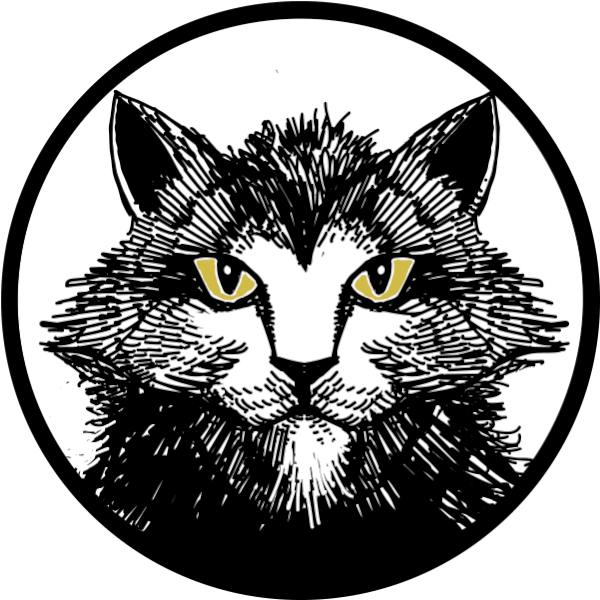
    Look into my eyes, baby

  • Mad Lich and the Gang – a Necropolis28 Gathering (2/2)

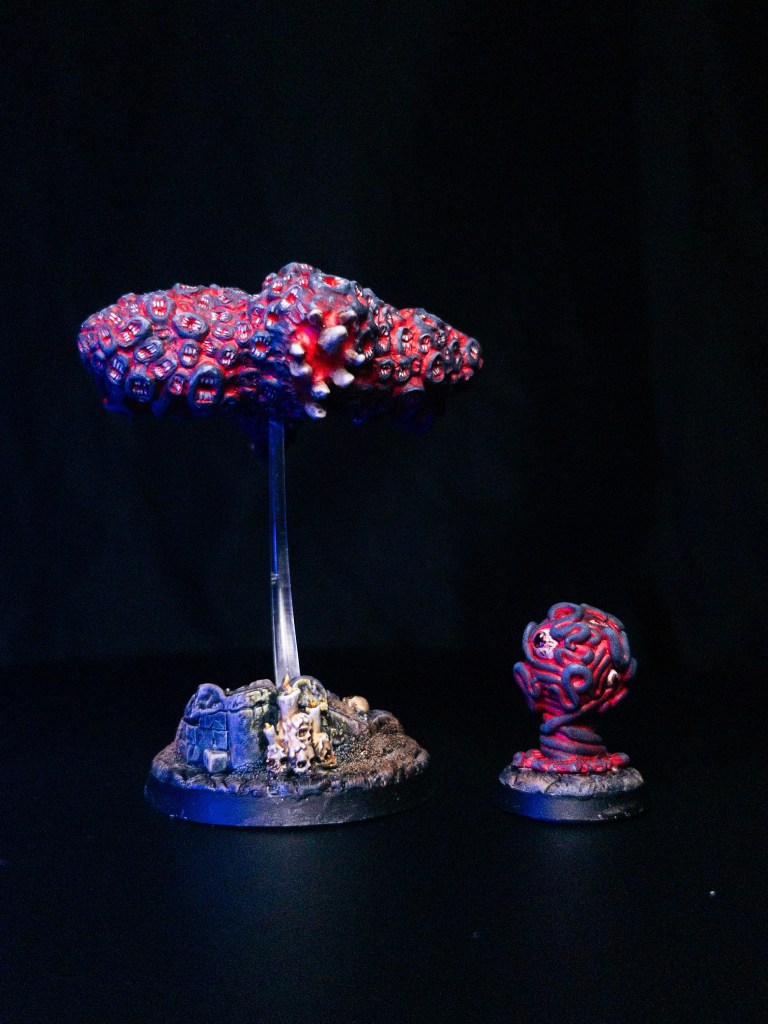
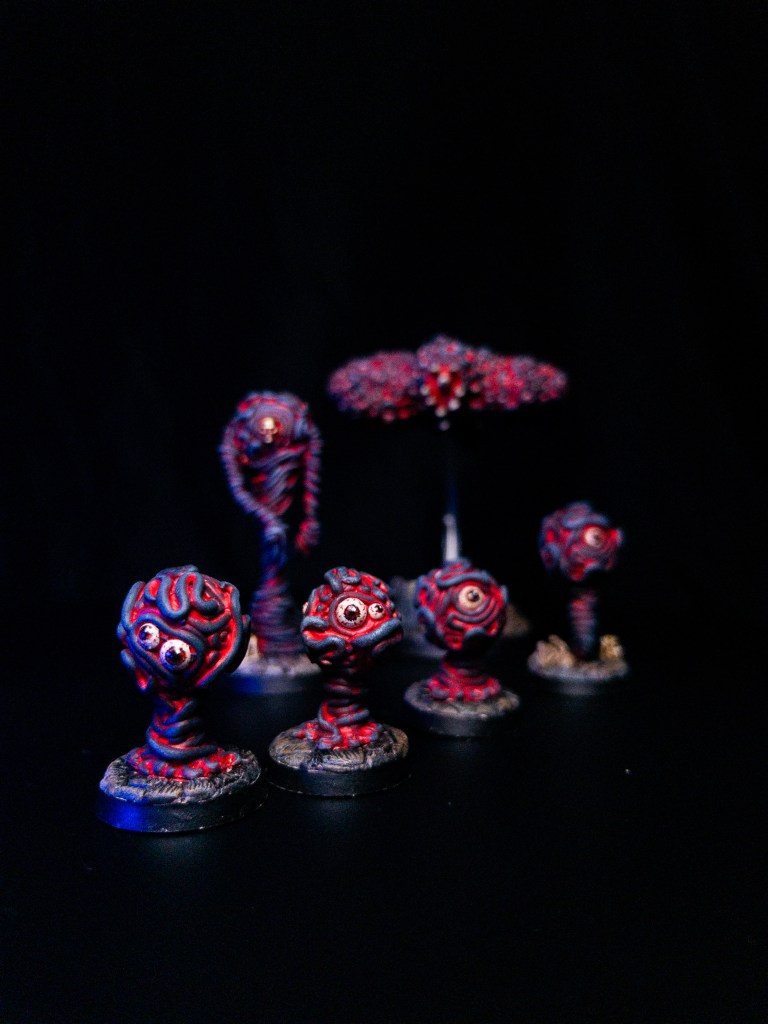
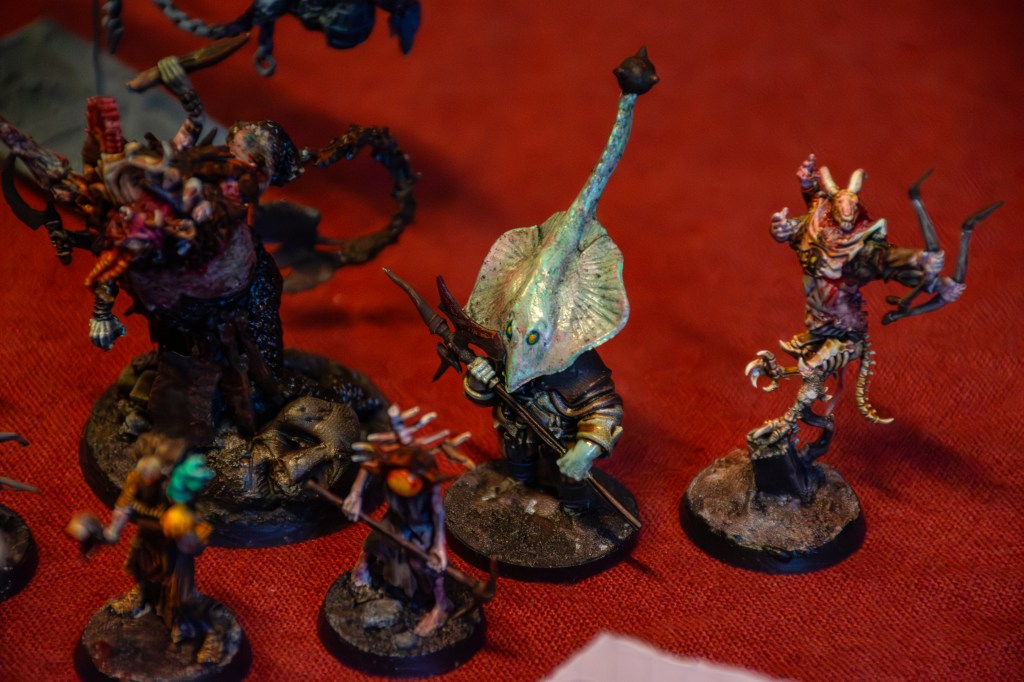
    We return to the tentacle boys and their ghostly shenanigans. This time the gang is completely assembled, bases are decorated. One could say they are primed, moisturised, hydrated, in their lane, ready to bring destruction to their undead foes.

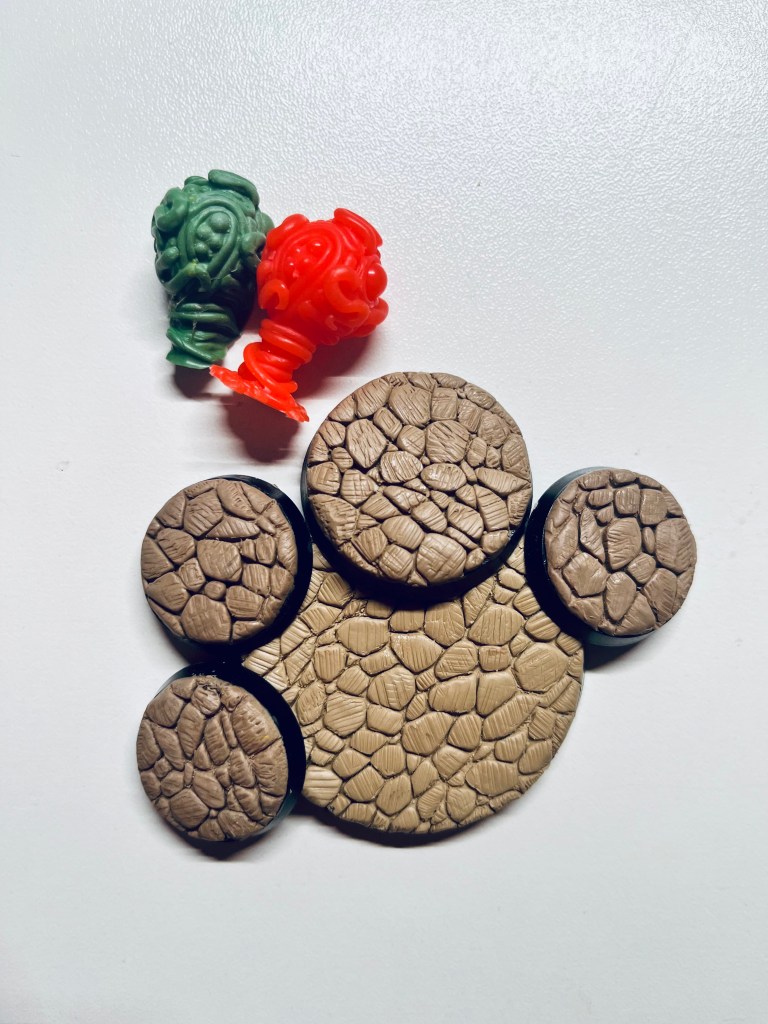
    For completeness’ sake, all the bases I also sculpted with Milliput and a cobble stone roller a dear friend of mine printed for me. The initial look was too “flat”, so I added more structure and dents on each cobble stone with my hobby-knife. Once the bases were cured, I also destroyed some of the cobble stones, and added random resin bits – the usual stuff: candles and skulls and candles on skulls. And fine sand, representing dust. A lot of dust.

    Once I was happy with the bases, I glued on the models. The big screamer on its flying stand was the most complicated to attach to the base. To avoid priming or painting over the transparent stick holding the monster up, I covered it with liquid silicone. This could be easily peeled off again, once the paint job was finished.

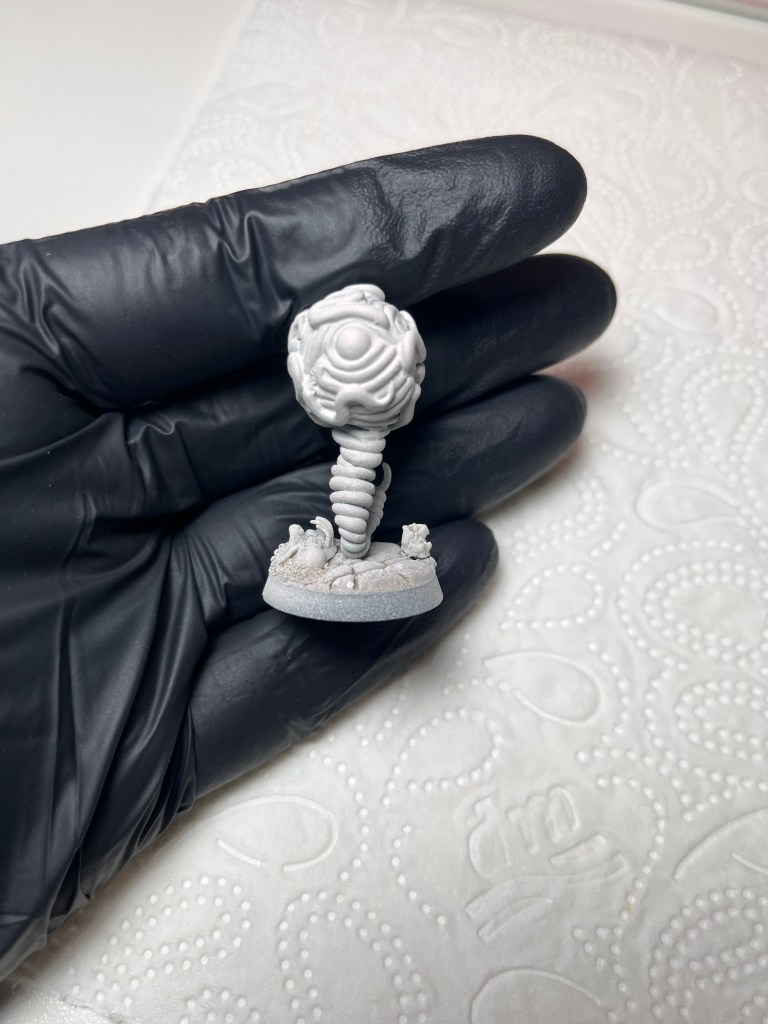
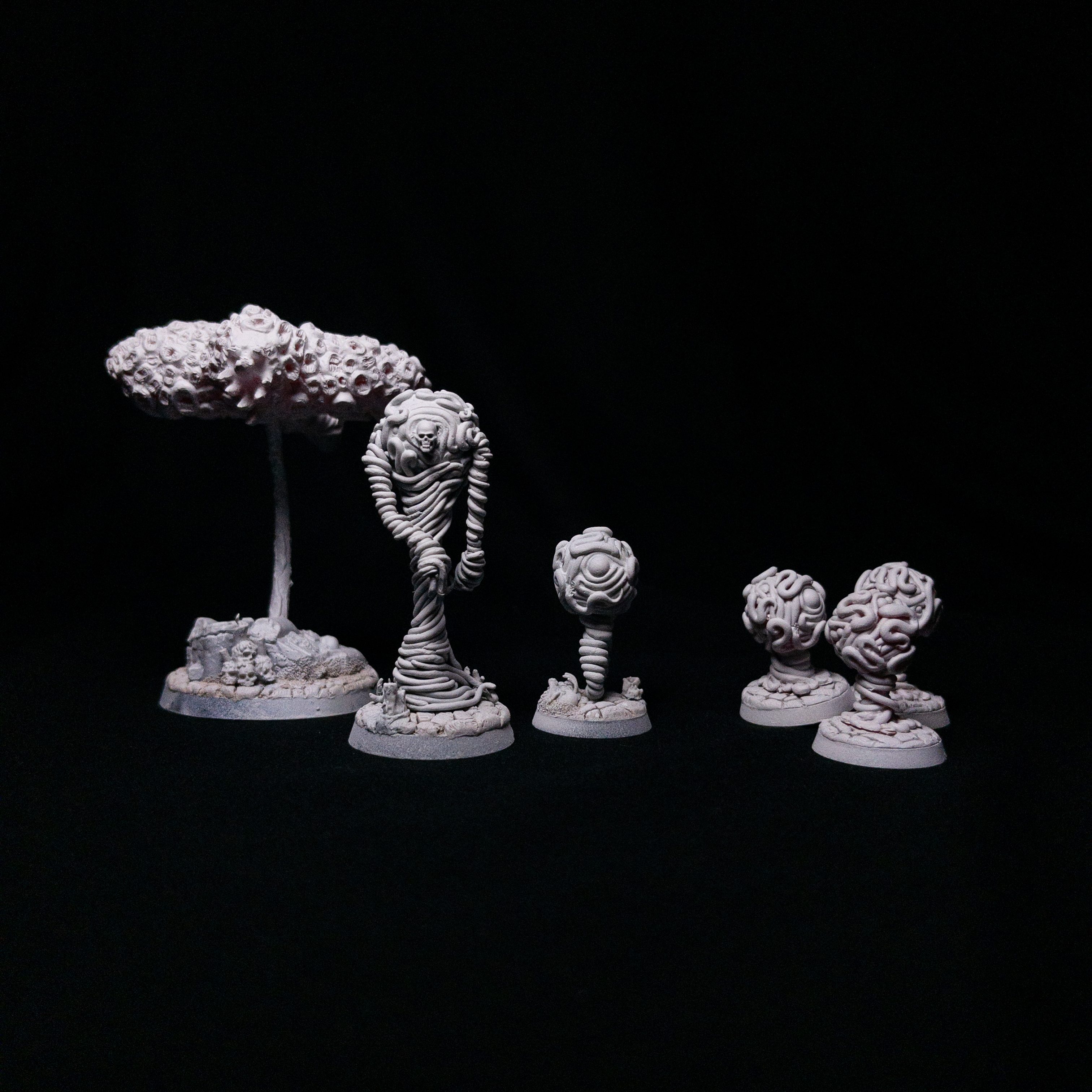
    All models were primed fully white – no zenithal shenanigans, and you will see in a minute why. Let’s bask in their “before picture” for a second.

    I still plan on expanding the gathering. Maybe add a Revenant that really looks distinct from the other models, but for now I think the selection I have should be sufficient for starter lists.

    Husk bombardment incoming, dear opponents.

    The painting plan was pretty simple – to convey the other-worldly, eldritch horror, they needed to glow. Of course. Which means we are going for a light-to-dark-to-light paint job. This is totally an actual art term, if you ask me.

    The colours I used were only five (all Army Painter):

    • Power Node Glow
    • Vermillion Red
    • Matte Black
    • The Darkness
    • Ivory White

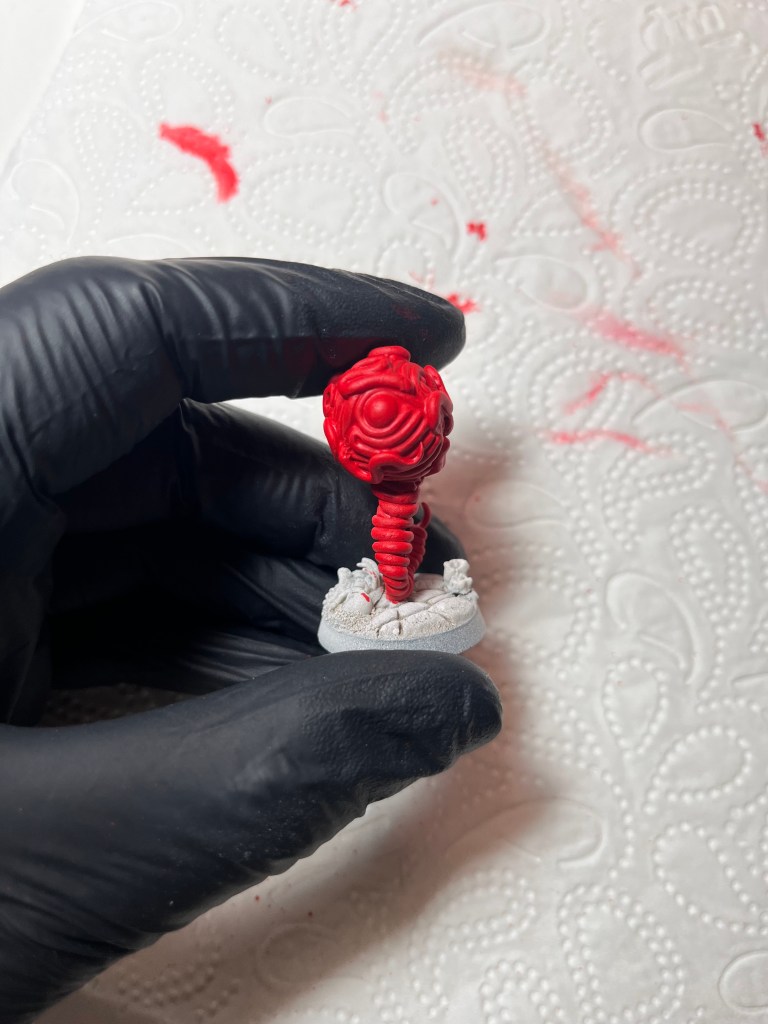
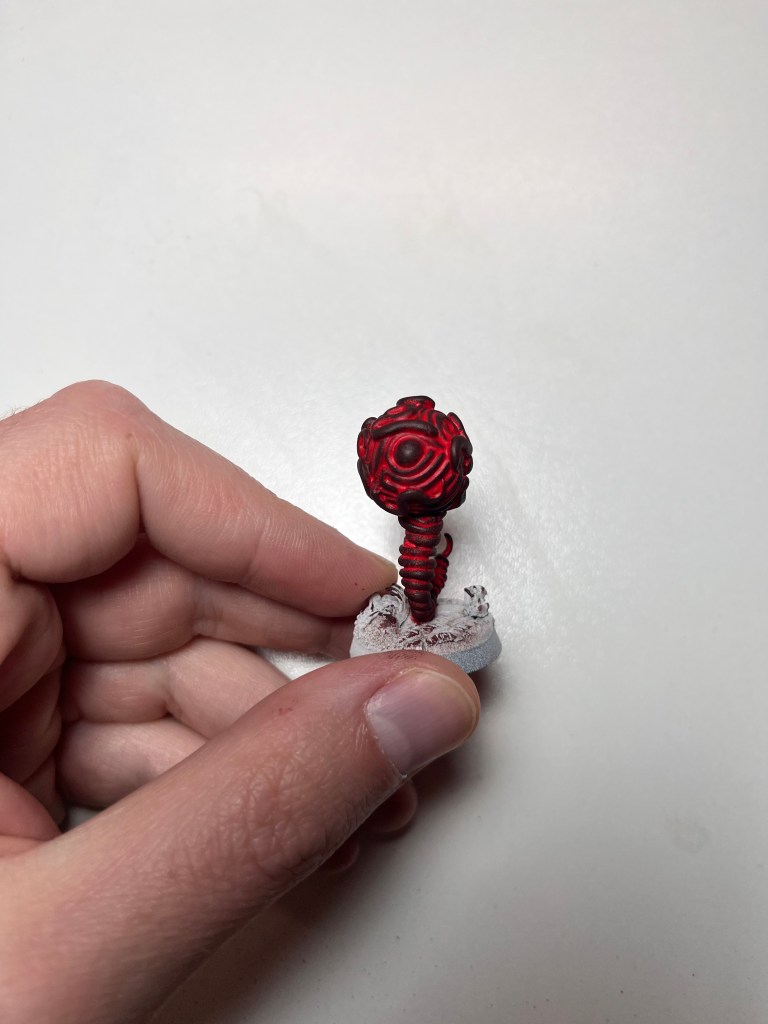
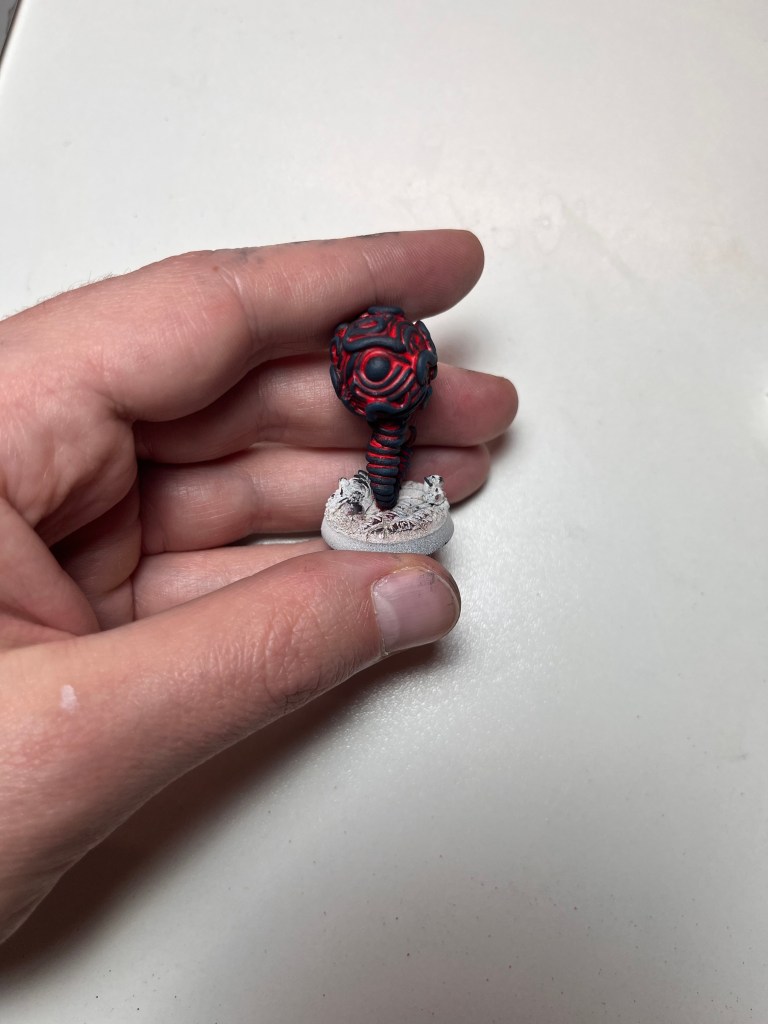
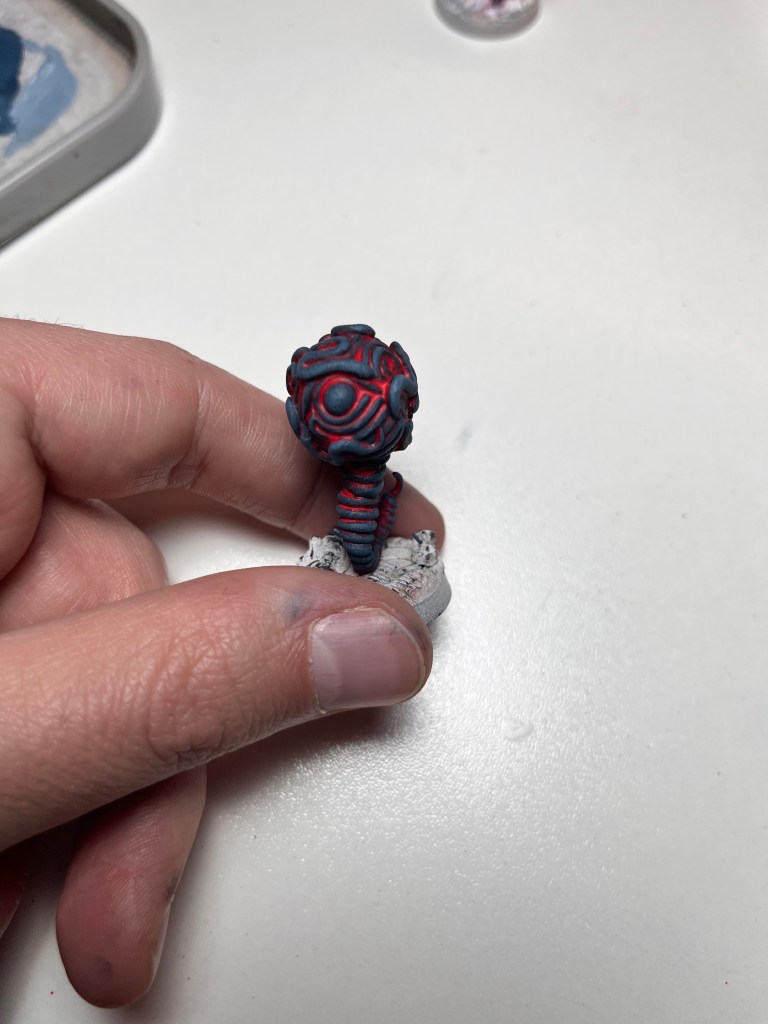
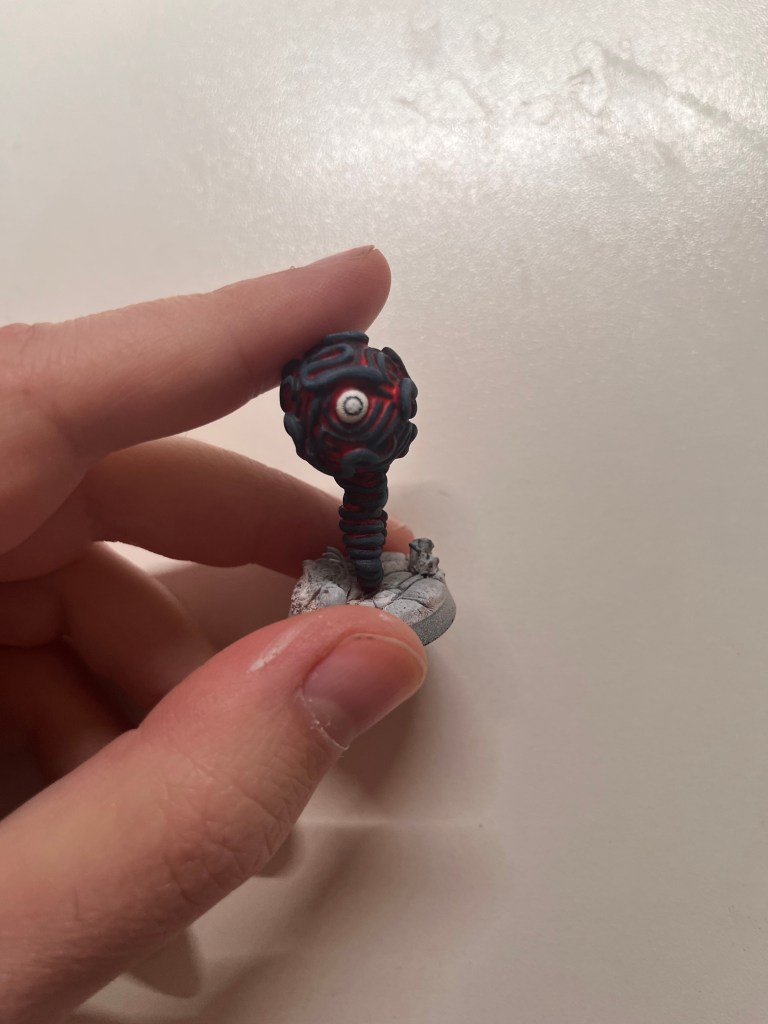
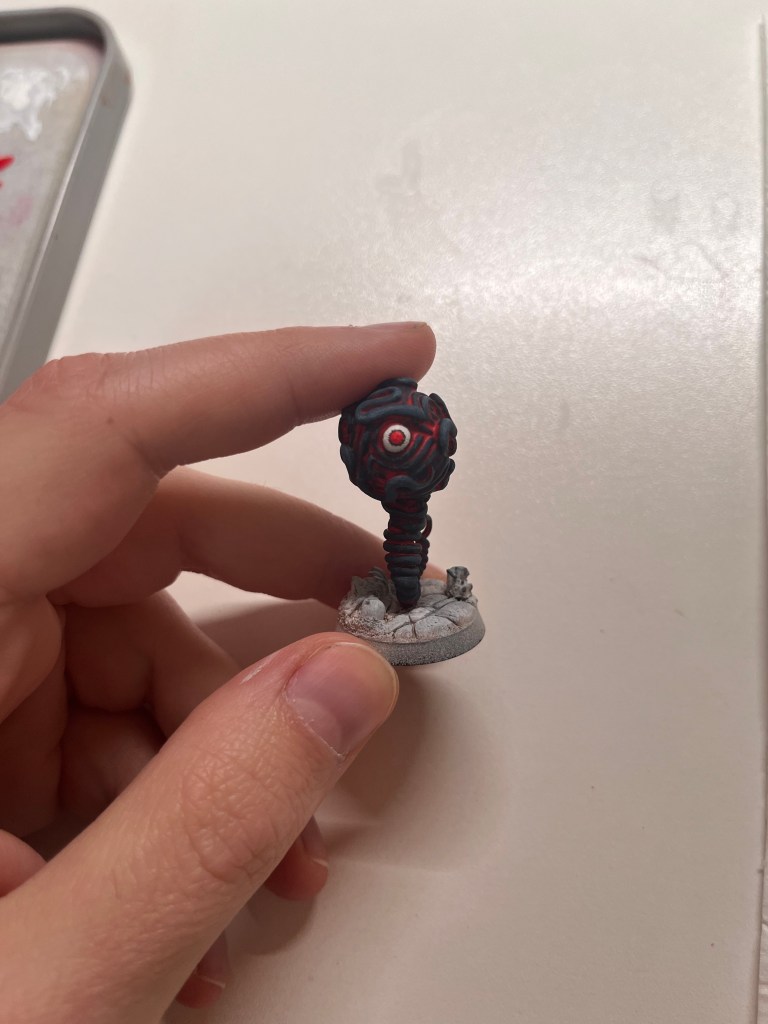
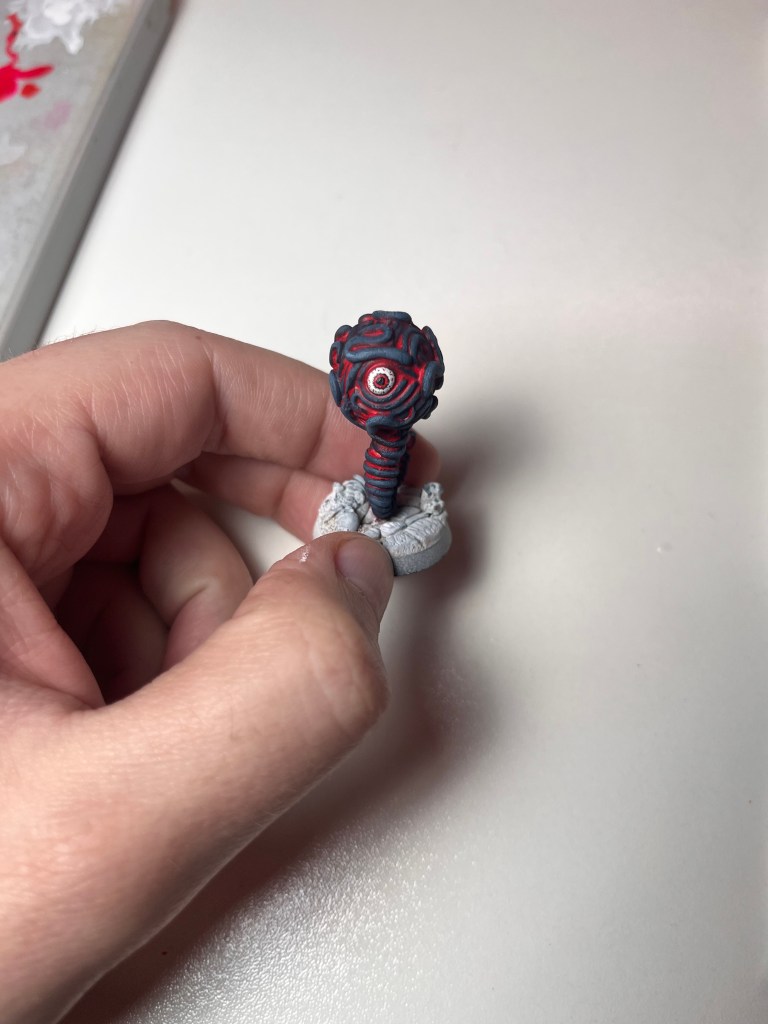
    The main goal was to have a complementary effect of the blueish black of the The Darkness with the very bright red (almost magenta-pink) in the recesses between the tentacles. As a thematic contrast, all the eyes would then be painted with actual fleshy colours. The base layer was a mix of Power Node Glow with just a tiny bit of Vermillion Red, followed by dry brushing the model while adding Matte Black to the bright red paint until I dry brushed it with pure black. Then I started with The Darkness, and added with 2 more steps more Ivory White to it. At the end I gave the models even some light edge highlights with a very desaturated light blue. See the step-by-step on this little familiar:

    I was asked how I did the eyes, and the photos show, it couldn’t be simpler. Base coating the eye ball white, then adding a circle with The Darkness, followed by another, smaller white circle within (to have a light undercoat for the Vermillion Red), followed by another smaller black circle. At the end I added one white dot in the corner of the pupil, to simulate a wet and glossy effect. With a super thin brush (I use a cheap nail art brush) I added some random red streaks that should represent blood vessels in the eye ball. Once done, I drenched the eye in gloss varnish and Mod Podge.

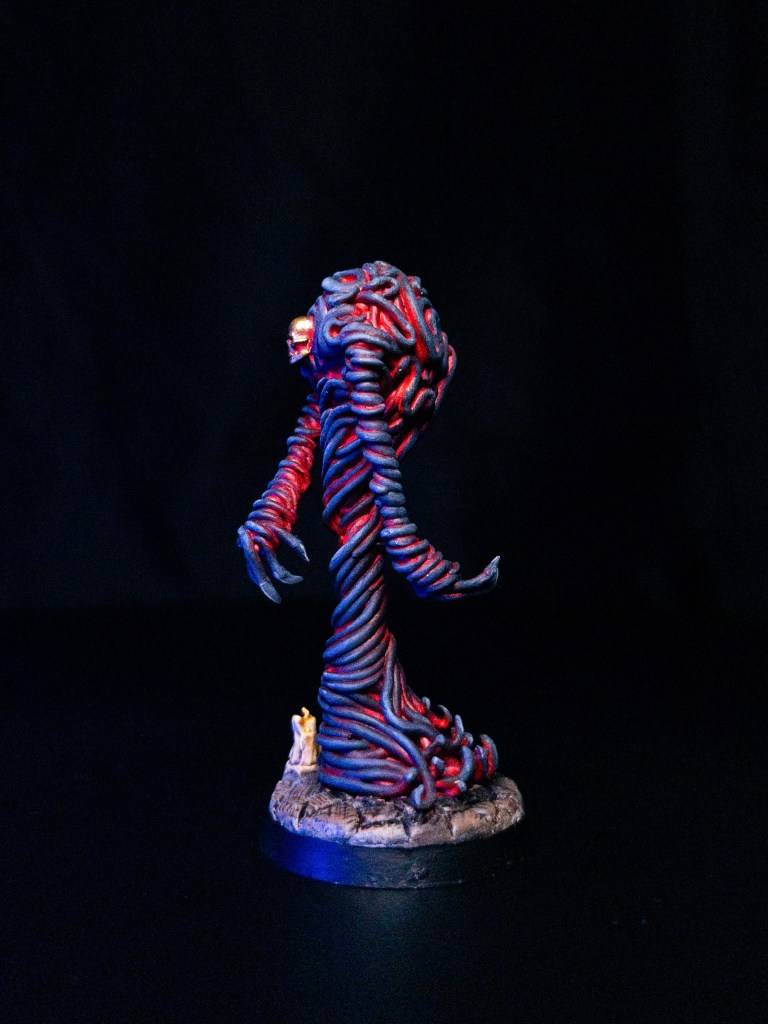
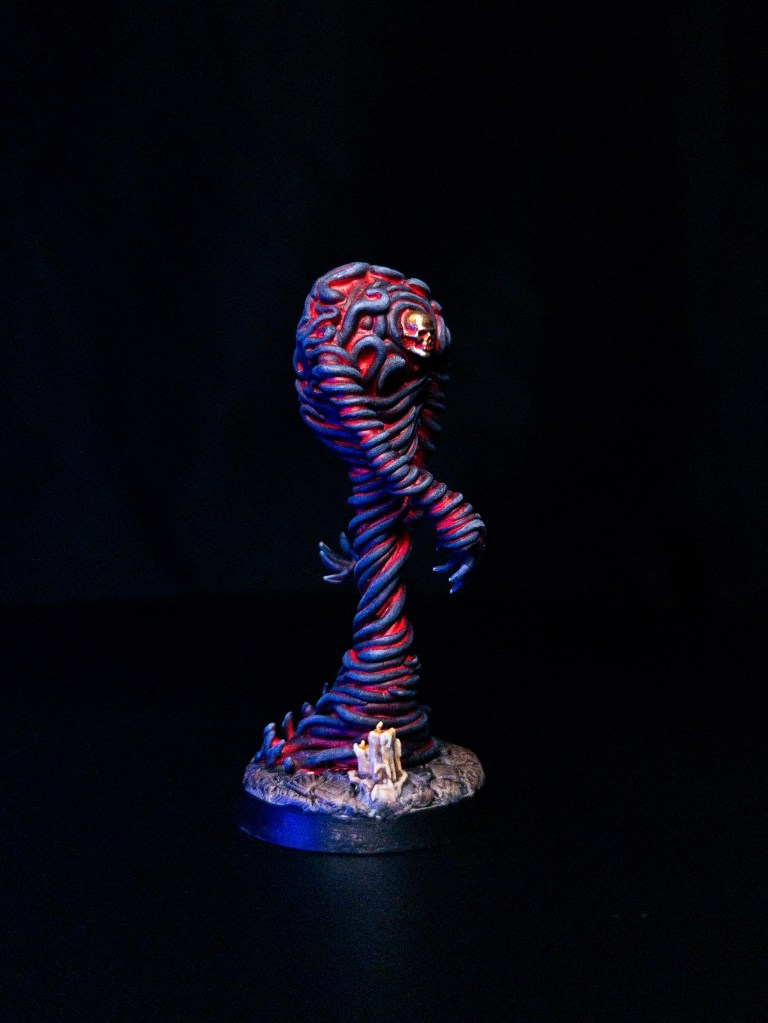
    The Lich had two extras: claws and as the only model in the Gathering an actual skull. These needed to be highlighted somehow, and for the claws I decided that I would drive the highlights to an extreme, light blue to pure ivory white, while the skull would get a gold treatment – to really shine visibly and bright from the dark backdrop of the tentacles.

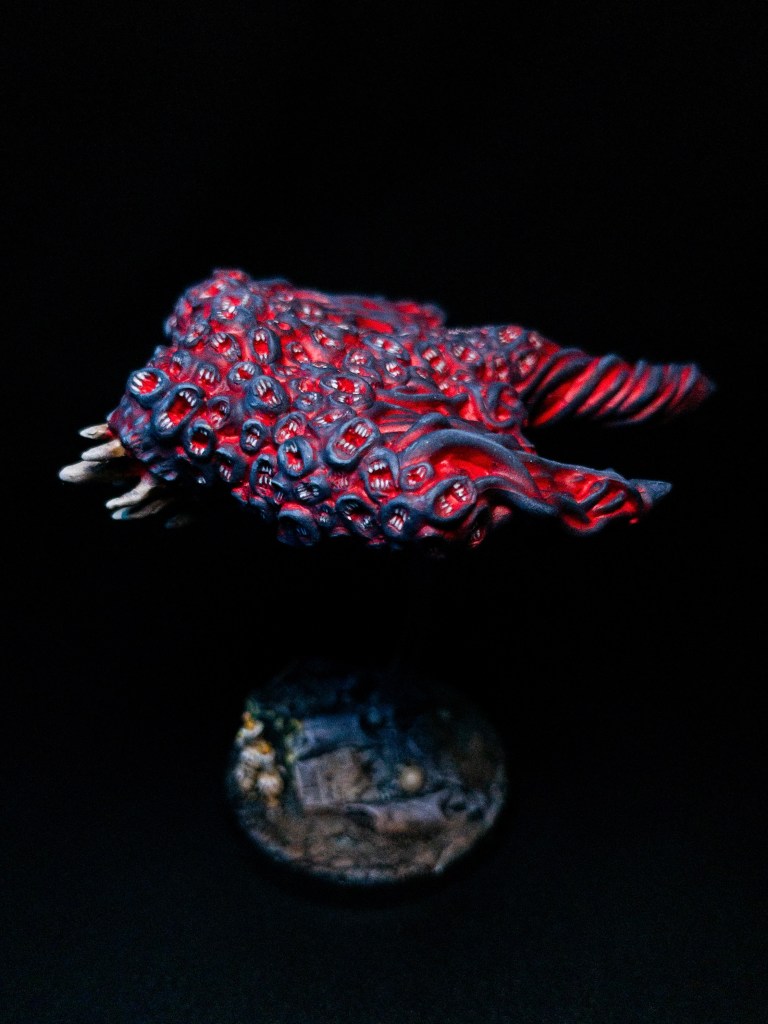
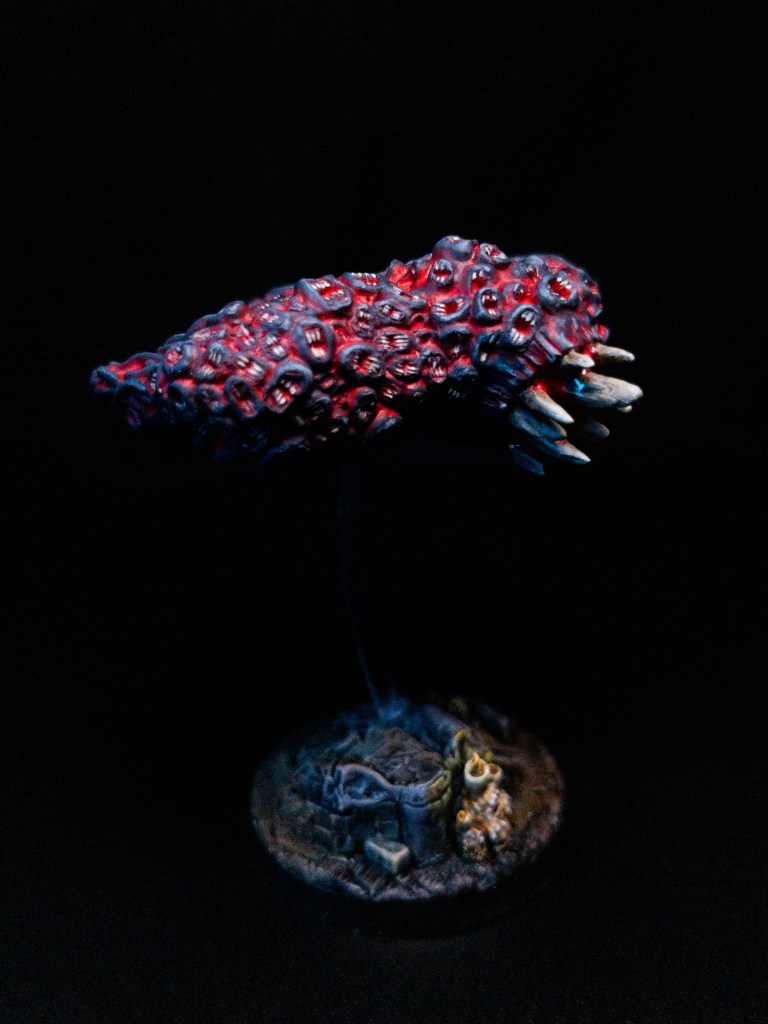
    The colossal monster was the most fun but also the most tedious to paint. The mouths would not have the desired effect if one would just drybrush over the teeth. Hence, I highlighted the teeth individually, to an almost matte white. It took ages, but I love the result.

    And with the black base rim, some dry brushing of the bases and some very light OSL, I called this project done for now, and present you the finished Mad Lich and the Gang. At some point, I will write up some lore on this Gathering. For now, have some photos.

  • Mad Lich and the Gang – a Necropolis28 Gathering (1/2)

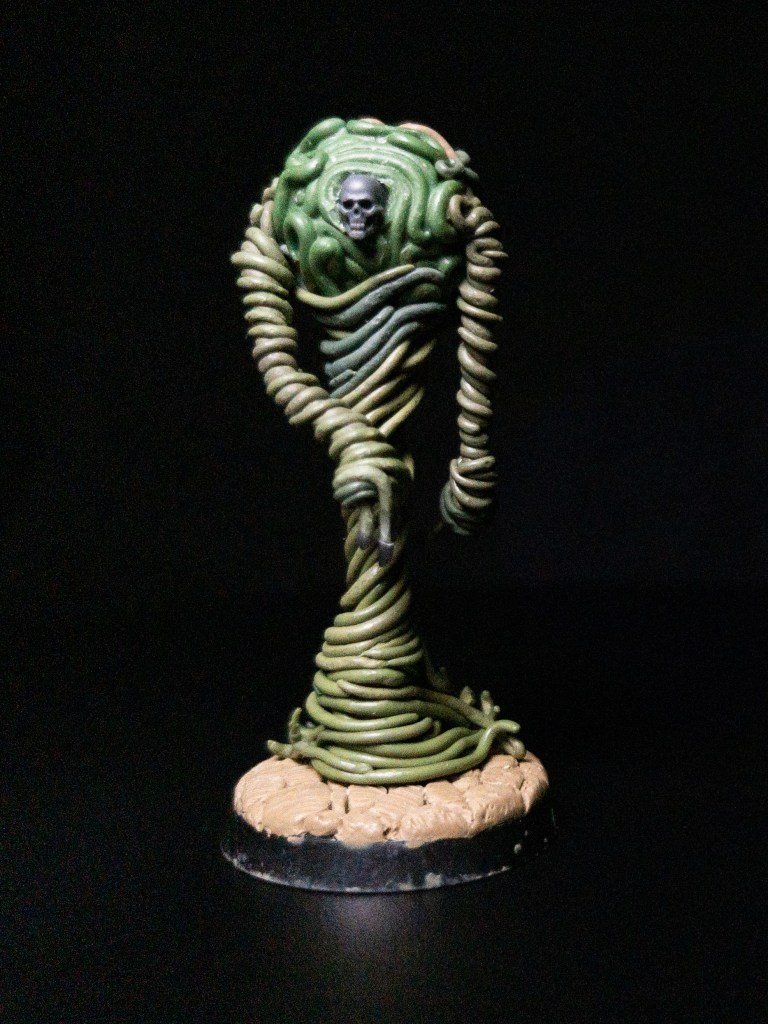
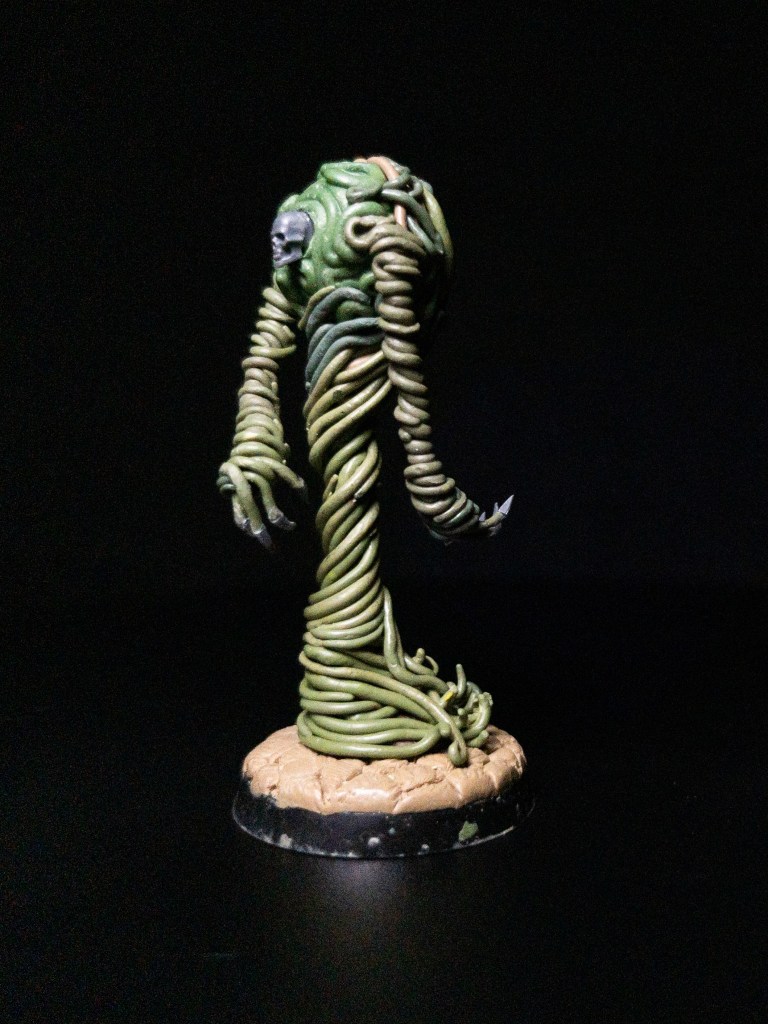
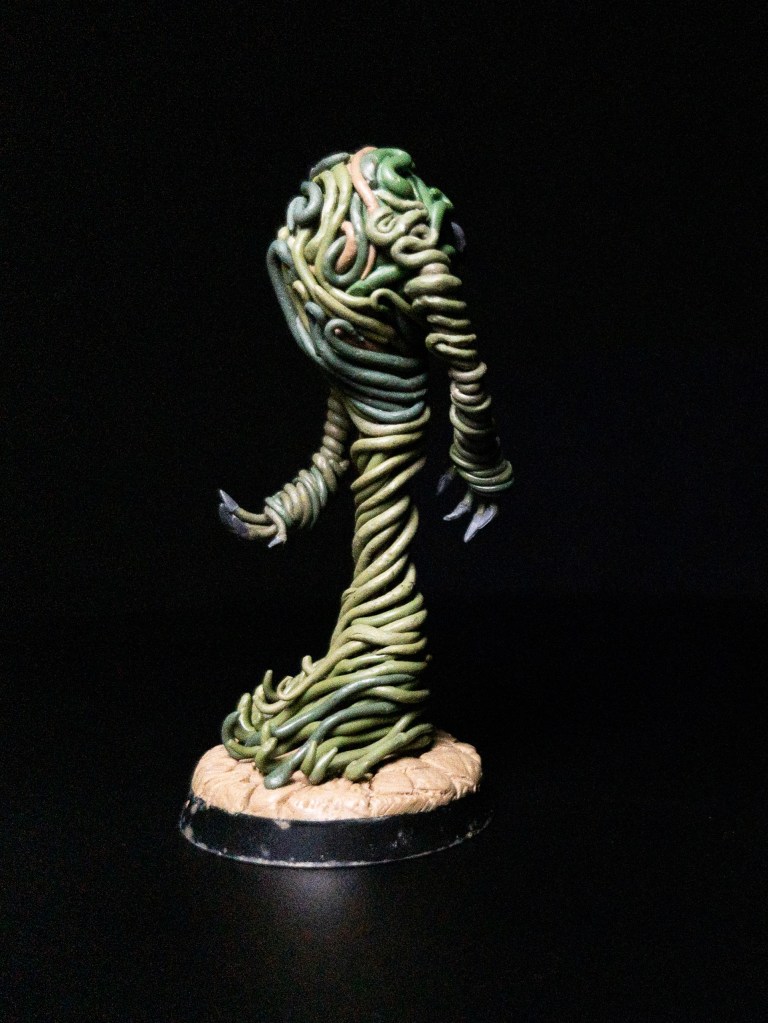
    Over the holiday period I’ve started a project of bashing and sculpting a new Necropolis Gathering, with the goal of really trying to improve my sculpting skills. Given that we are starting basically from zero skill over here – not a tall order. Greenstuff fills gaps in my usual hobby life, but not much else. This blog post will focus on the inspiration behind the warband and how the idea emerged while bootlegging some minis that I acquired recently.

    I am assuming that you, dear reader, are familiar with Necropolis, and if you are, skip to the next paragraph. If you are not, it’s a skirmish wargame of undead warbands fighting it out on 16×16 inch boards, all set in a dead city-setting. You should go straight to the Necropolis Patreon, stare in awe at the evocative art that conveys the setting created by Peter (@owlshield), download the latest ruleset and maybe even head over to the BlightBones Patreon and stare in awe at the minis that Ryan (@blightbones) sculpted for the setting. It goes without saying you that can use any minis you want to represent your undead warband, and on the official Discord you can see how creative the community is. Big things are coming in 2026, as we will get a physical release of the Necropolis rule book, and I couldn’t be more excited. Back to the hobby project.

    I wanted to create a plasm gathering conveying an eldritch horror vibe. The feeling you get from taking the wrong turn in Elden Ring and getting beat up by some dungeon boss and its retinue. Giving the “ghostly” warband a corporeal form that still defies any logic. This vague idea collided with some minis I purchased off of Keira (@keira.kreations) at Kamping Kitbash last year.
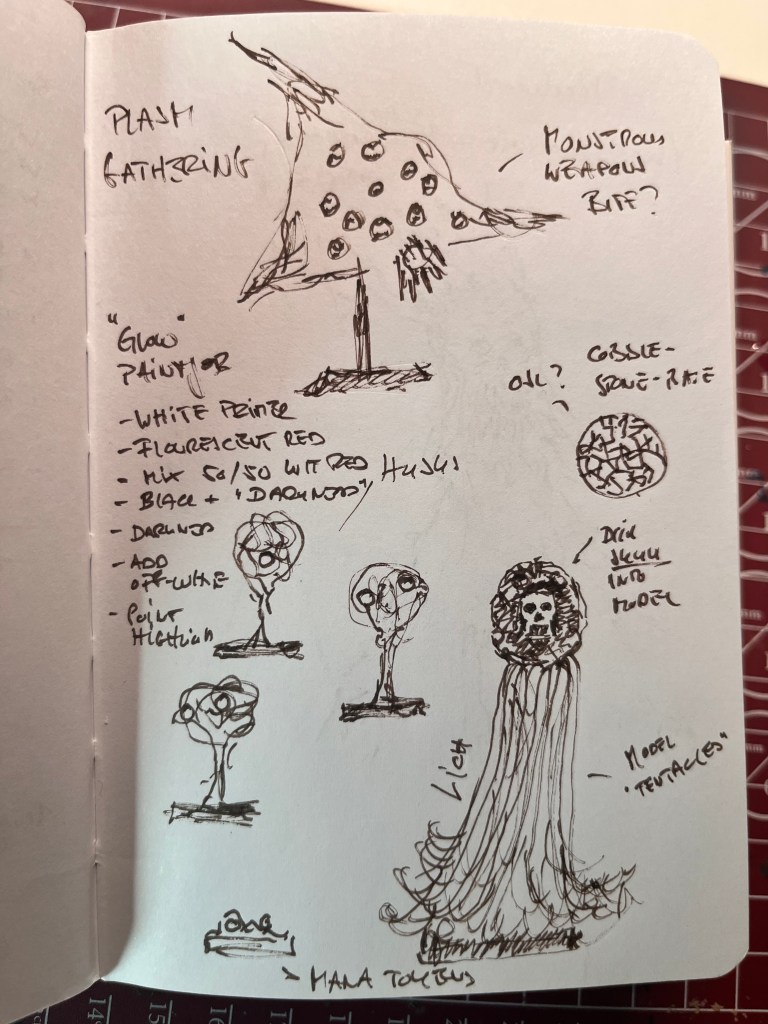
    At the time I wasn’t sure where to use them, but all the weird, wiggly demons and the big flying monster had me hooked, and I knew I’d use them for something. While they were sitting on my desk for a while, the concept started to emerge in my head. During a long train ride for work I even scribbled some of the ideas into my sketchbook. Behold my absolute mediocre drawing skills and unintelligible handwriting:

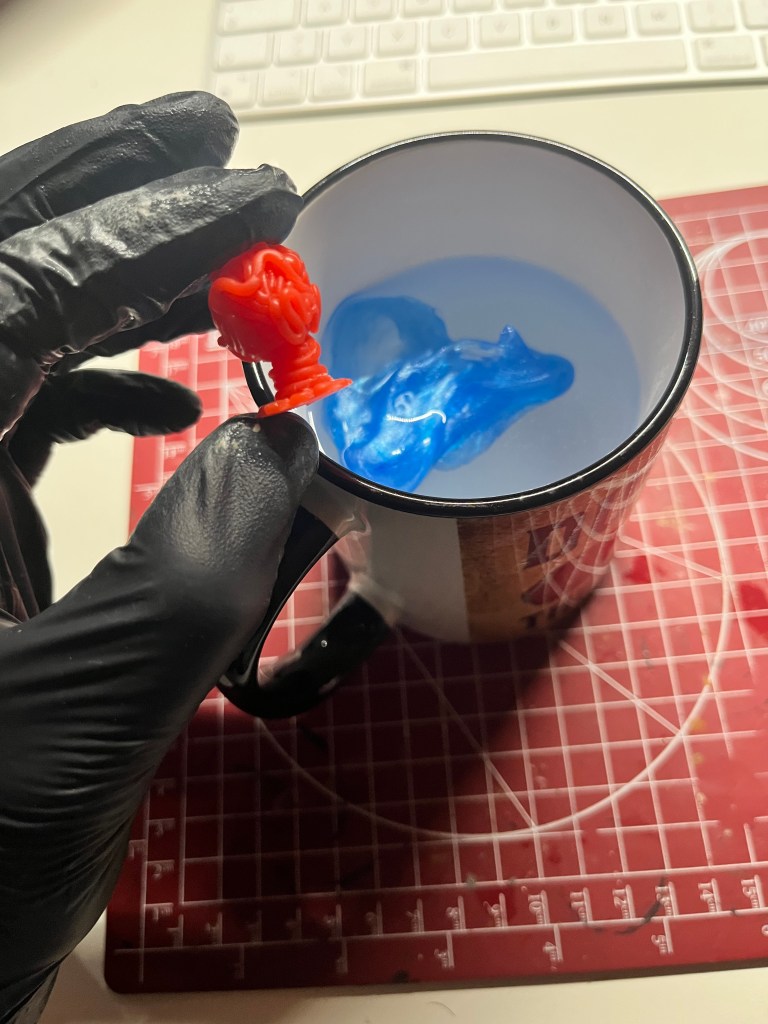
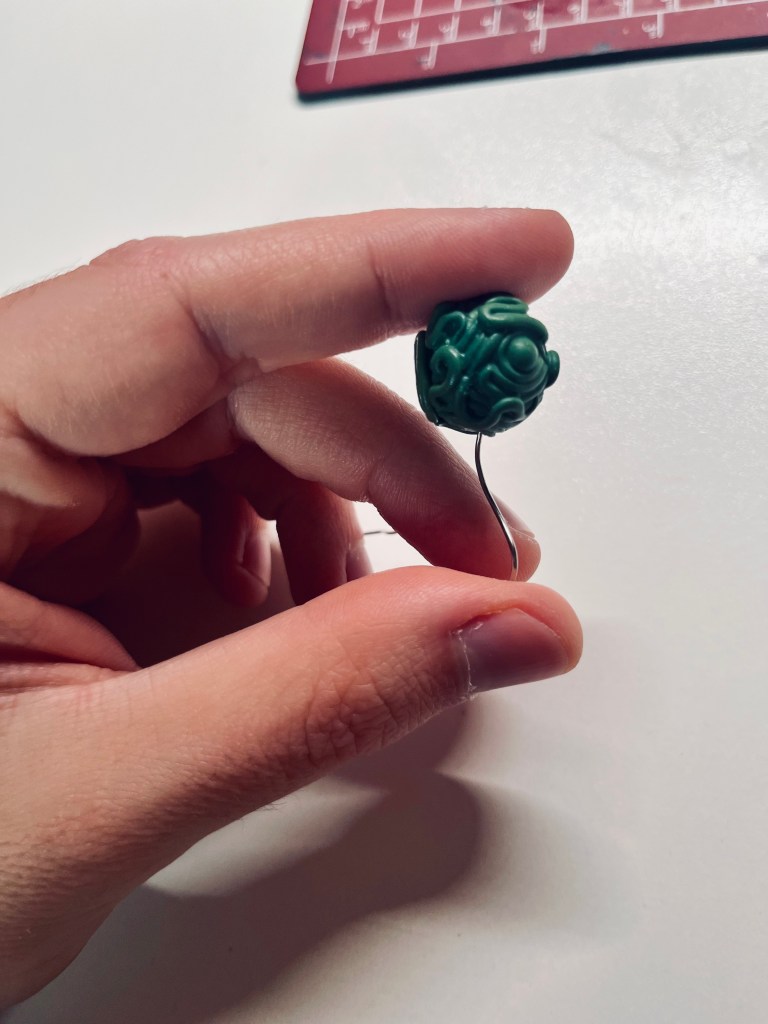
    So with the model count I had, I could create several husks, I had the colossal monster, but I wanted to bash a Familiar and a Lich. So I bootlegged a few of the small tentacle monster heads with Oyumaru (What is Oyumaru?) and had a look if I could use them.

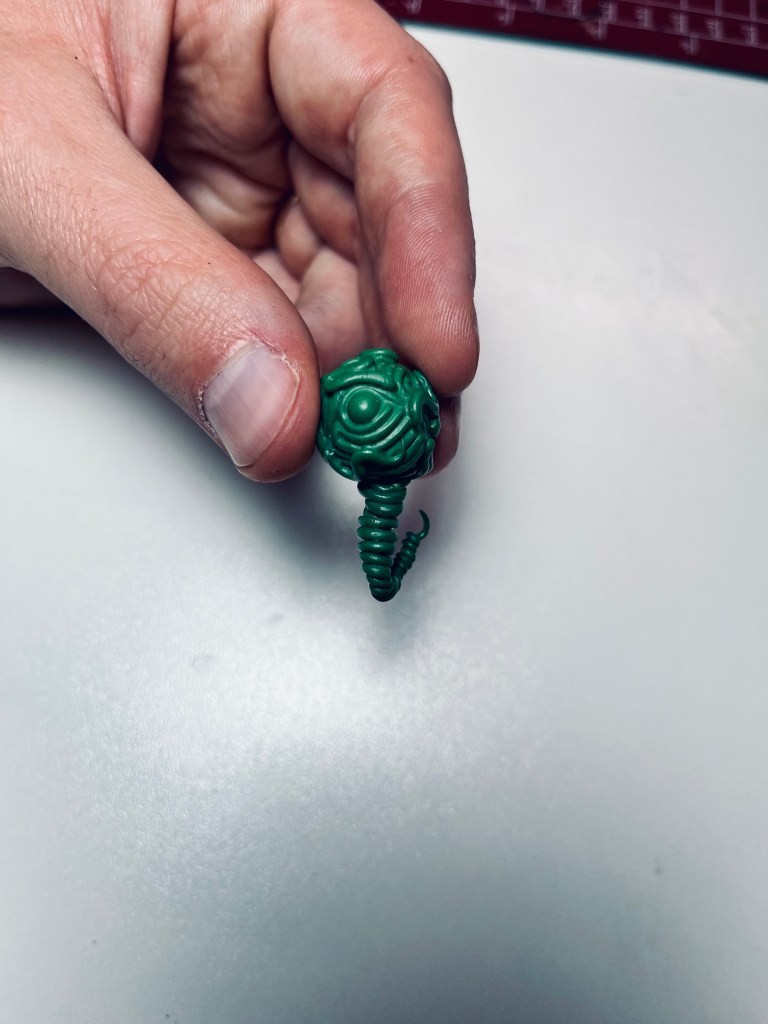
    One turned out to have a perfect scrying eye, so my Familiar was born. Hungry for mana tokens lying around, it would float higher than the husks above the battlefield – all I needed to do was to sculpt an elongated, snake-like body and put it on a base. That was actually easy, rolling up Greenstuff and folding it carefully around a bent paper-clip until it had the right shape.

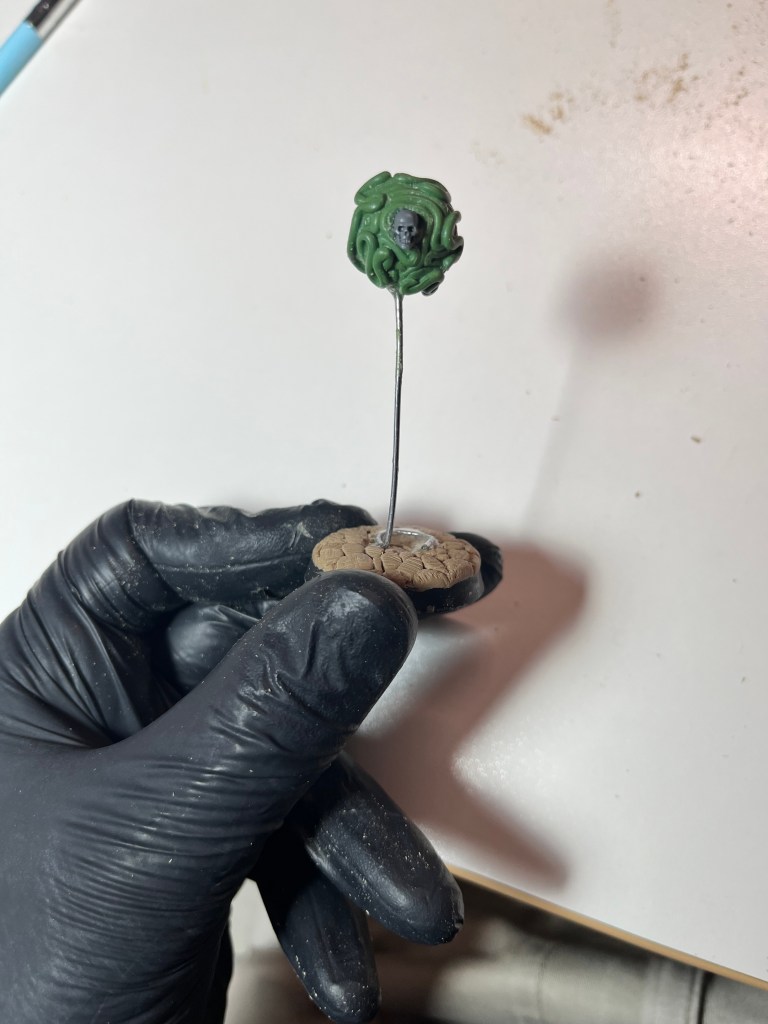
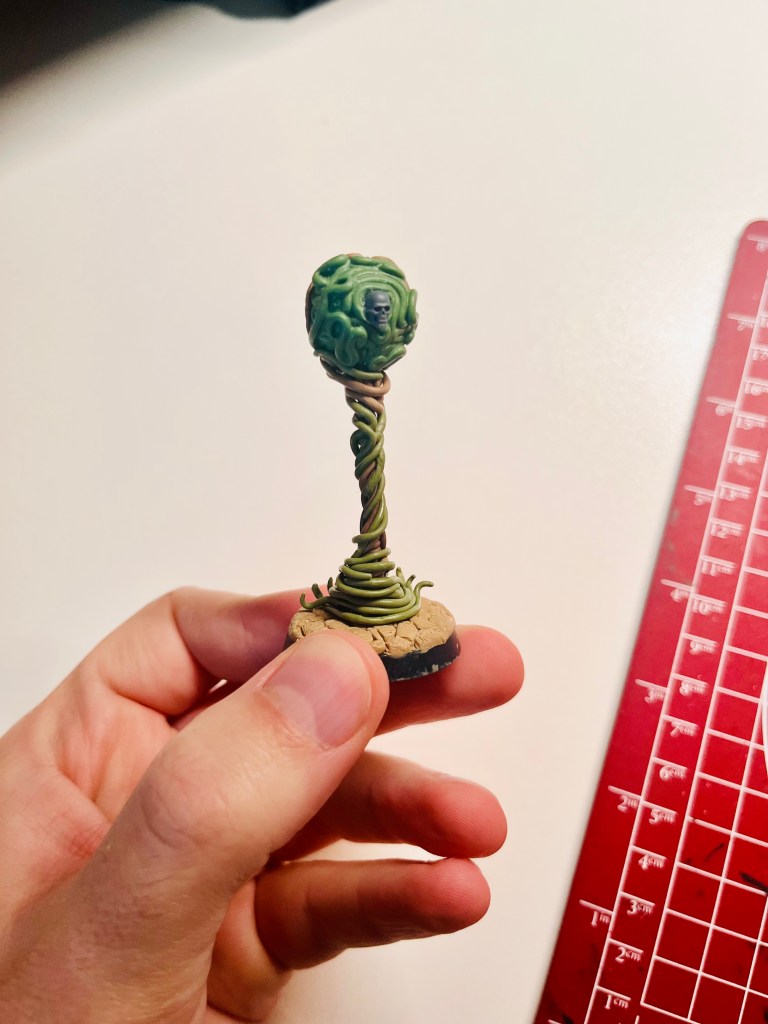
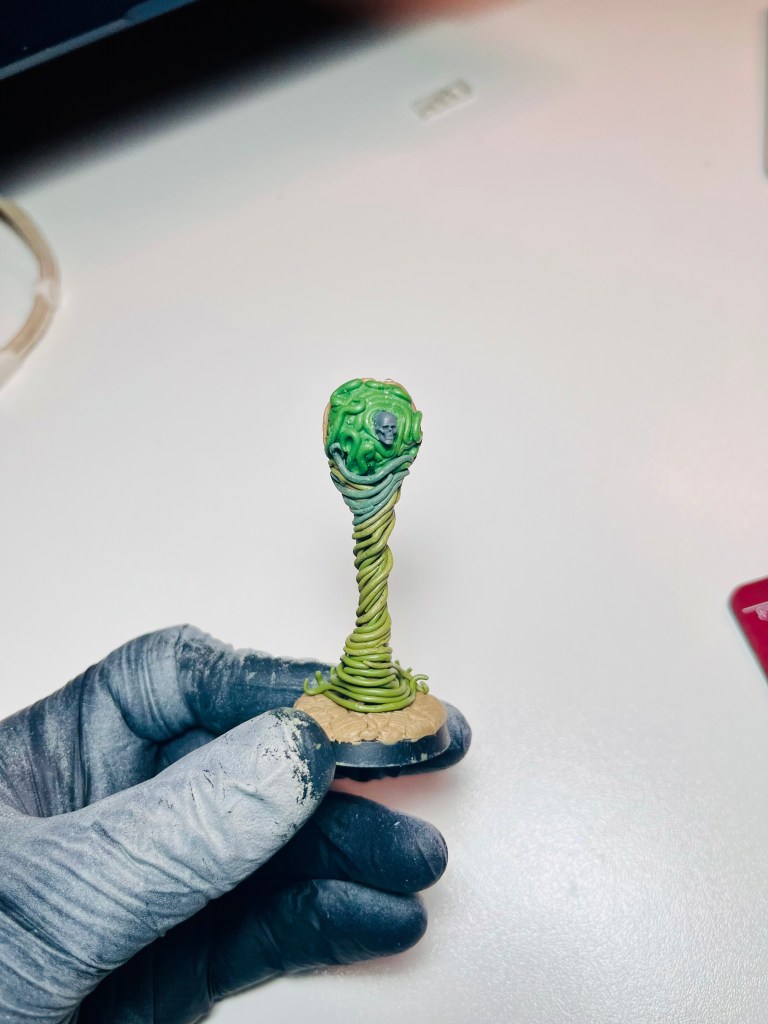
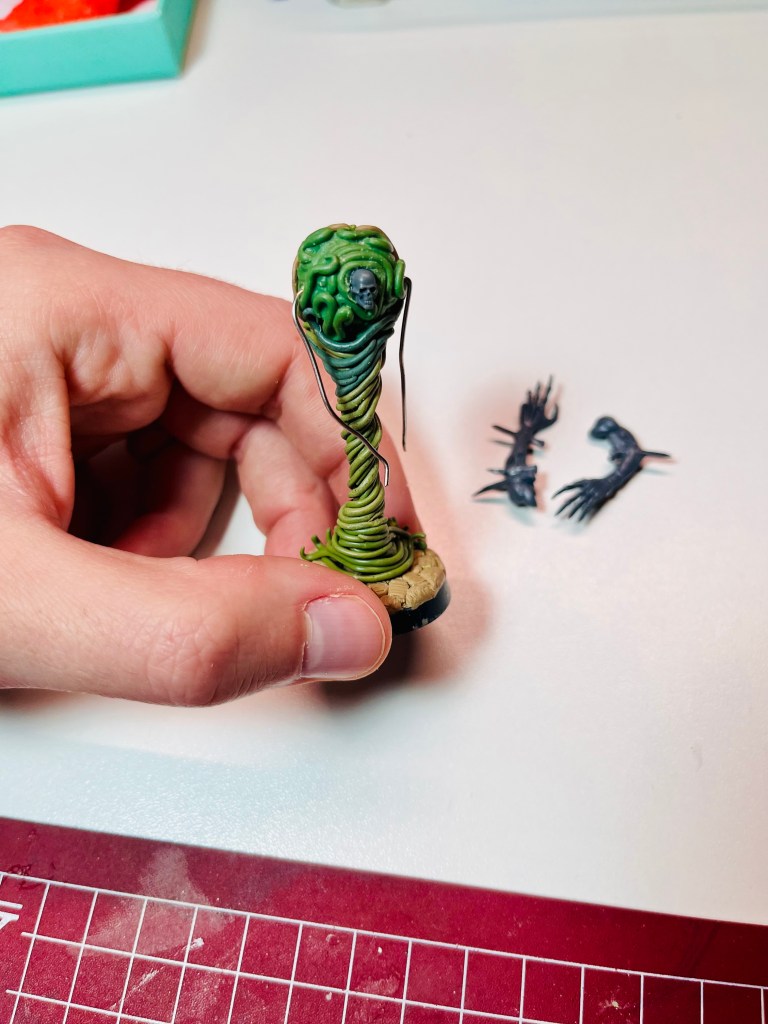
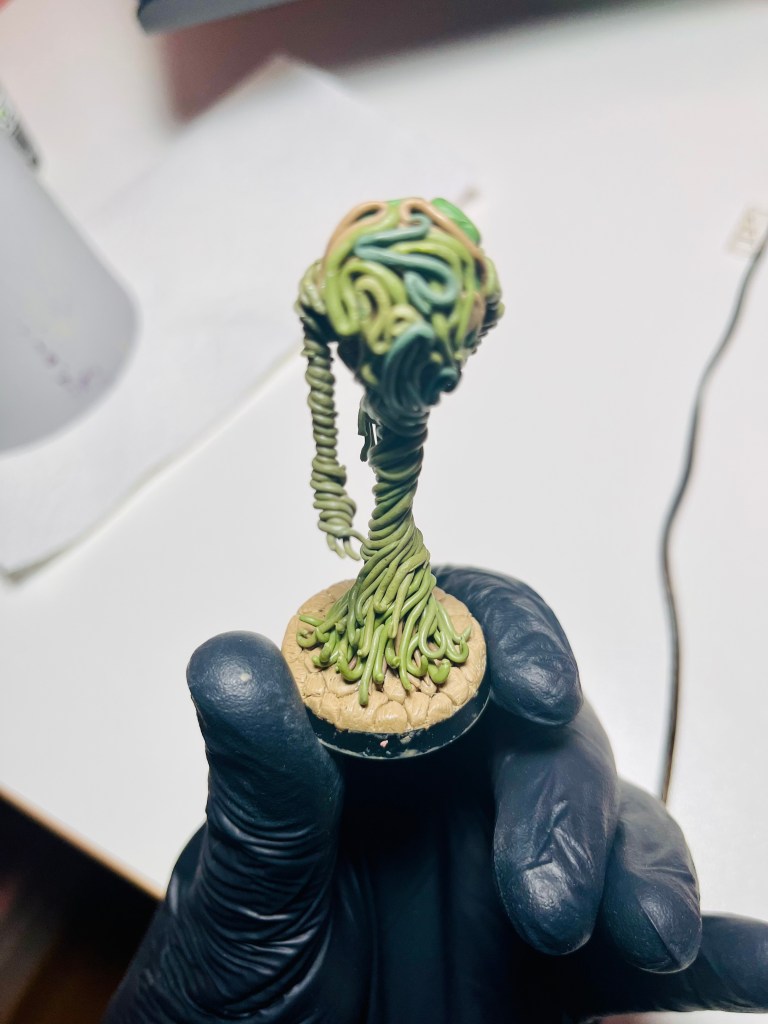
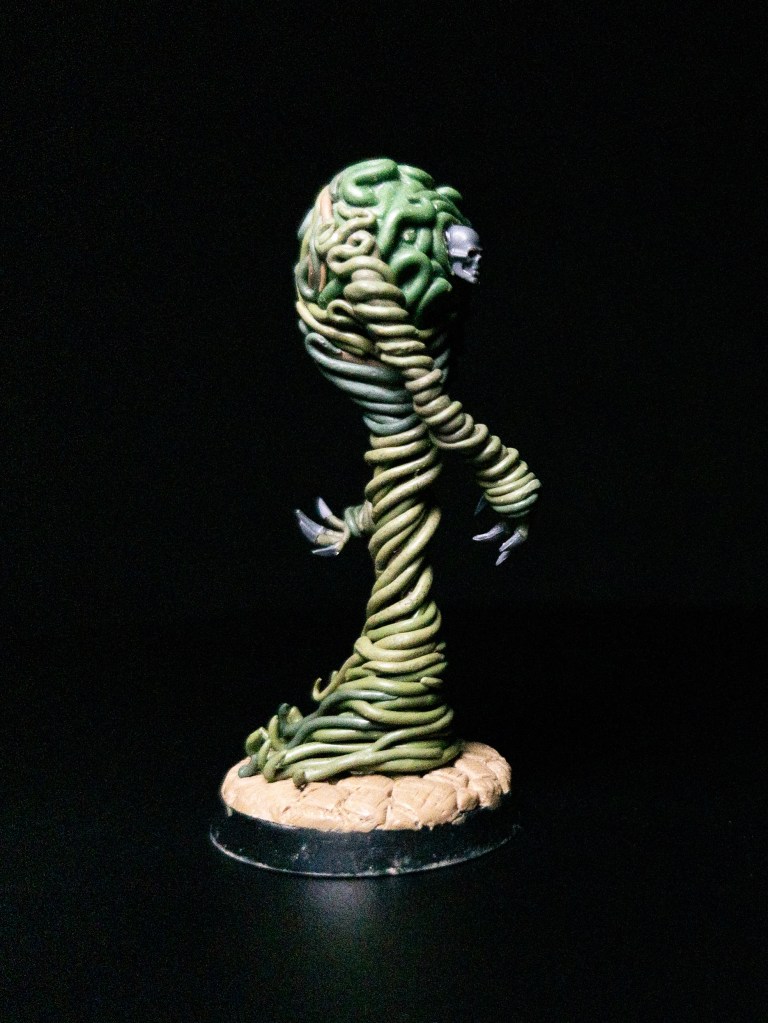
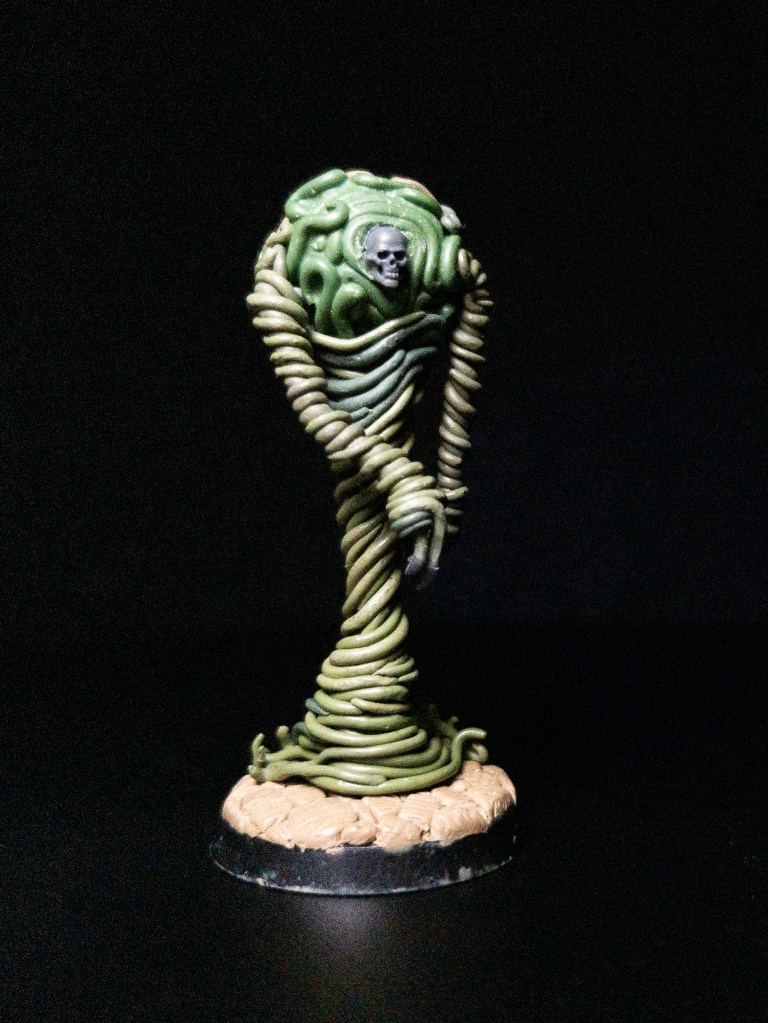
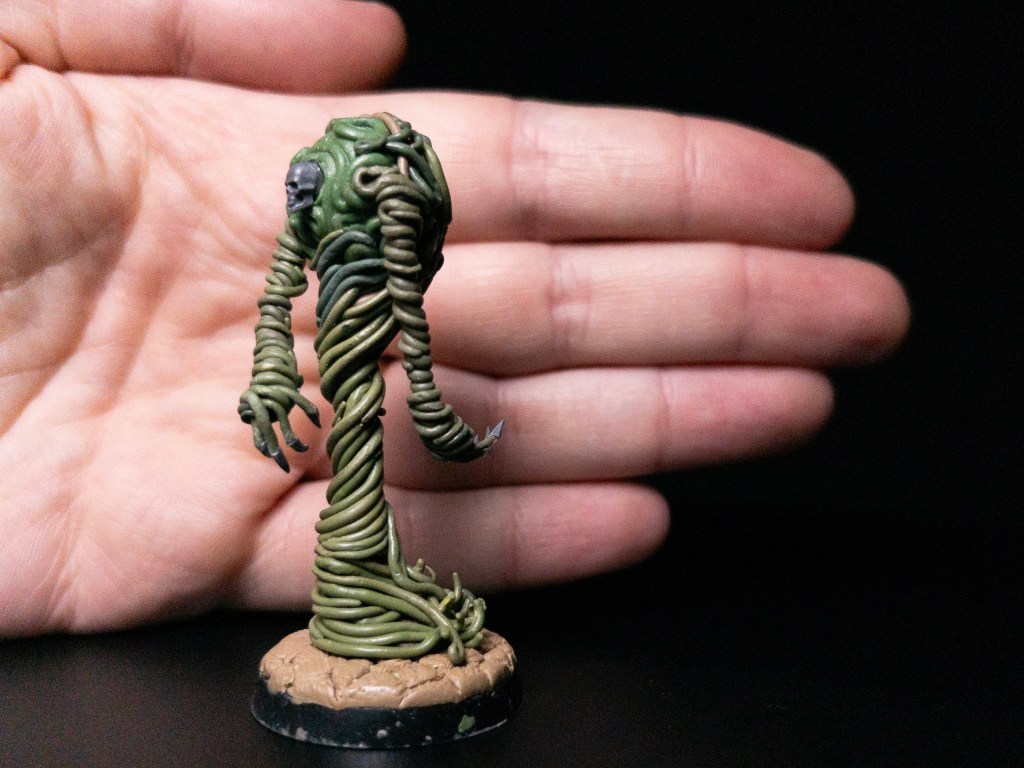
    Then came the Lich. Of all the monsters in the Gathering, it should have the closest form that would resemble something humanoid, while still remaining a weird, writhing, tentacly mess, with all the wrong proportions. While thinking about how to sculpt this, I even came up with my own head-canon and lore, why the Lich is the way it is, but that’s for another blog post. I took one of the bootlegged demon heads, and found a perfect spot to drill a dent into it, and glue a single skull into it. Then putting that “skull-ball” again on a bent paper-clip, I started slowly building up the form, layer by layer.

    Did I need to do it so carefully, or could I have taken some shortcuts? In retrospect, yes, as it ended up looking bulkier than I believed it would be, but also no, because the slow build up of layers and layers of Greenstuff and Milliput strings helped me to slowly settle for the flow of its body and arms. Despite a more humanoid form, it still feels overall like a flowing being, due to the body being slightly contorted and the arms flowing in sync with it. This dynamic pose was the happy accident of the tedious process.

    And speaking of accidents, the various shades of brown and green tell a story of constant failure in finding the right balance of stiffness, stickiness and working time of the putty. I must have gone through at least 8 or 9 different mixing ratios of Greenstuff and Milliput until I settled on a rough 2:1 ratio (Greenstuff to Milliput) that just felt best to work with and wasn’t cured within 15 minutes.

    Two more lessons came with this project: contrary to painting, which often is very fast and loose (at least for me), sculpting required so (so so so) much more patience. The times I just had to stop and continue the next day (when the previous work was finally cured) were something really unusual for my work flow. Usually I tend to batch paint and mass-airbrush lots of models. Second, controlling the material and the way one uses one’s tools to spread the putty across the mini without it sticking and being pulled off is just half the equation – the other half is finding a way to hold the work-in-progress sculpt without squishing the previous steps. I cannot count how many times I realised 20 minutes later that I accidentally had brushed or pressed against some previous, uncured work and flattened it like a pancake.

    I know, for experienced sculptors this must be hilarious to read, but I will not pretend to be any of that, experienced or a sculptor. But if I can get such a unique mini done with my hands and my sculpting tools, anyone can.

    The five main points I learned:

    • Find the right mix of putty that fits your work style or the project.
    • Keep your tools moist at all times.
    • Be patient. A mini can take a week to be sculpted, layer by layer.
    • And for the love of everything that is unholy, find a way to hold that mini firmly, without touching your work.
    • Oh yeah, bonus: wear gloves, at least finger gloves. It avoids fingerprints.

    Since people might ask what tools I used: nothing fancy really. It was a pointy needle tool (that I created during a workshop with @conjuredcraft – but really anything holding a needle will do), my hobby knife and one silicone tip tool you can find for very cheaply on that billionaire hell site.

    Given that this was my first serious attempt at sculpting something, while not being fully from scratch, but remixing Keira’s work and working off of her idea, I am quite pleased with the result. Safe to say, I’m hooked. I know digital sculpting is probably more accessible and all the rage right now, but there is something so intensely rewarding in shaping with one’s hands something out of a raw material that does not involve any screen. 10/10, can recommend, will do again.

    Till next time, when we document the painting of the Gathering.

  • Blanche who?

    I am far from someone who likes to bash Games Workshop. The worlds, games and stories created by the company are the gateway drug for probably 99% of all hobbyists, and even today, where my playtime of GW-related games can be measured in hours per year, I dislike the hate that I sometimes see. At the end of the day we are all just pushing war-dollies around. Play Warhammer, however you want. A company is not your mum. If you are cheeky, play your Old World Army with OPR.

    Now, getting to my point: I fully understand that Games Workshop today is a company worth 6.5 billion pounds, and I understand that Warhammer has become the consumer-facing brand and IP of said company. It’s converting new and old players alike and selling them plastic kits at a faster rate than can ever be played or assembled, let alone painted – despite understanding all of this: I really struggle with how GW treats its artistic roots and history.

    For the sheer fun of it, I bought the recent “50-Years Games Workshop” White Dwarf 518. It is a light read on the history of the company and its development across half a century. Surprisingly, it’s actually quite open about its DIY and punk roots, inspired by the Zeitgeist of Britain during that time. It does very much focus on the “commercial development” of the company, probably more than anything. Then you get to the art page-spread, showcasing artworks that shaped the imagination of entire generations of Warhammer fans.

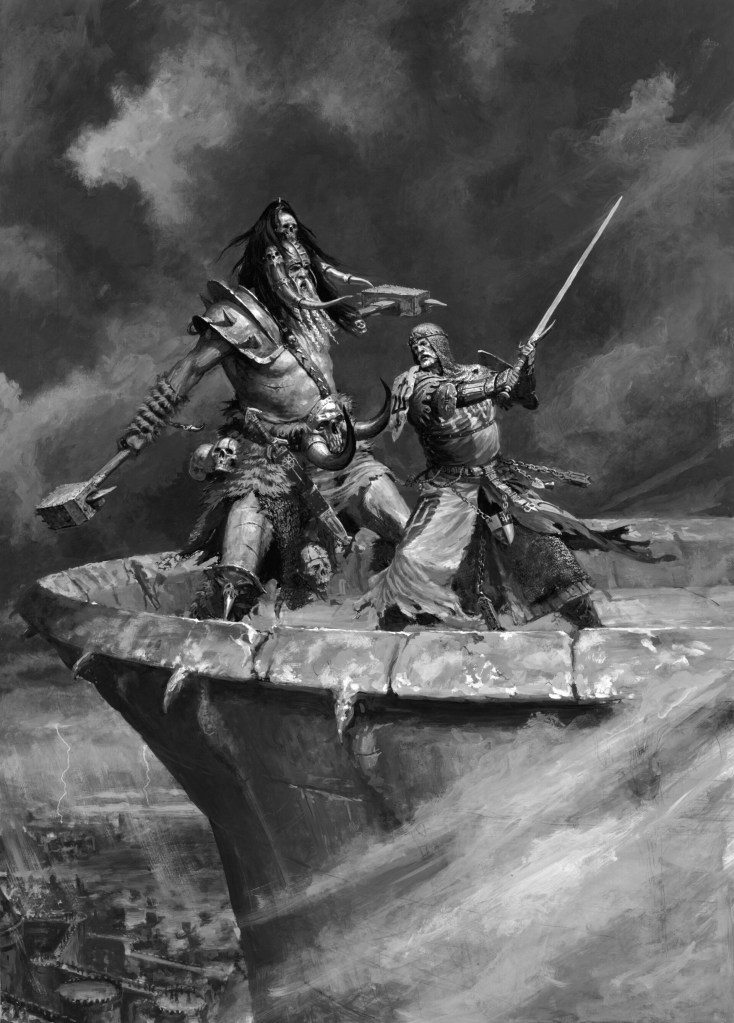
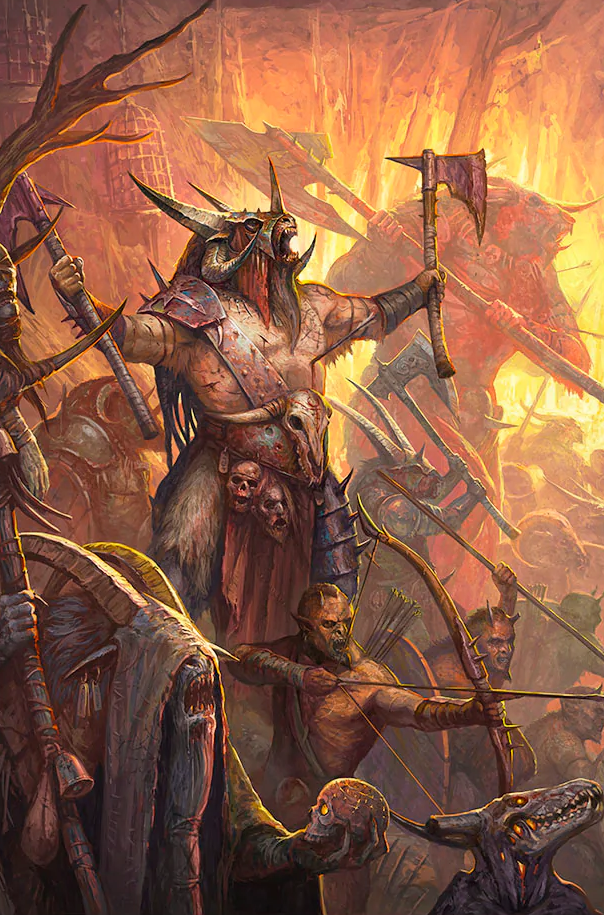
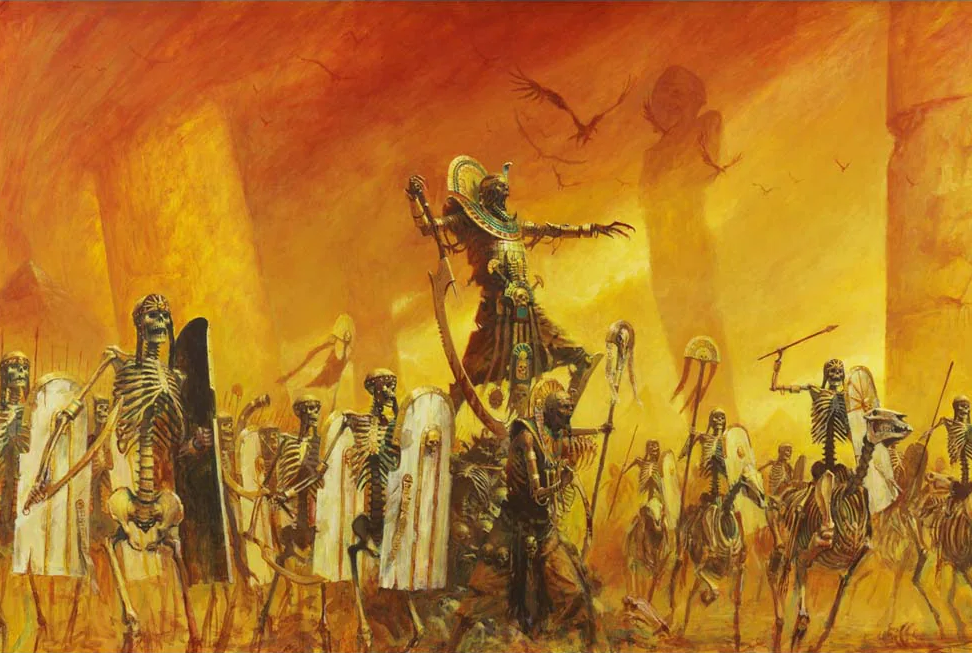
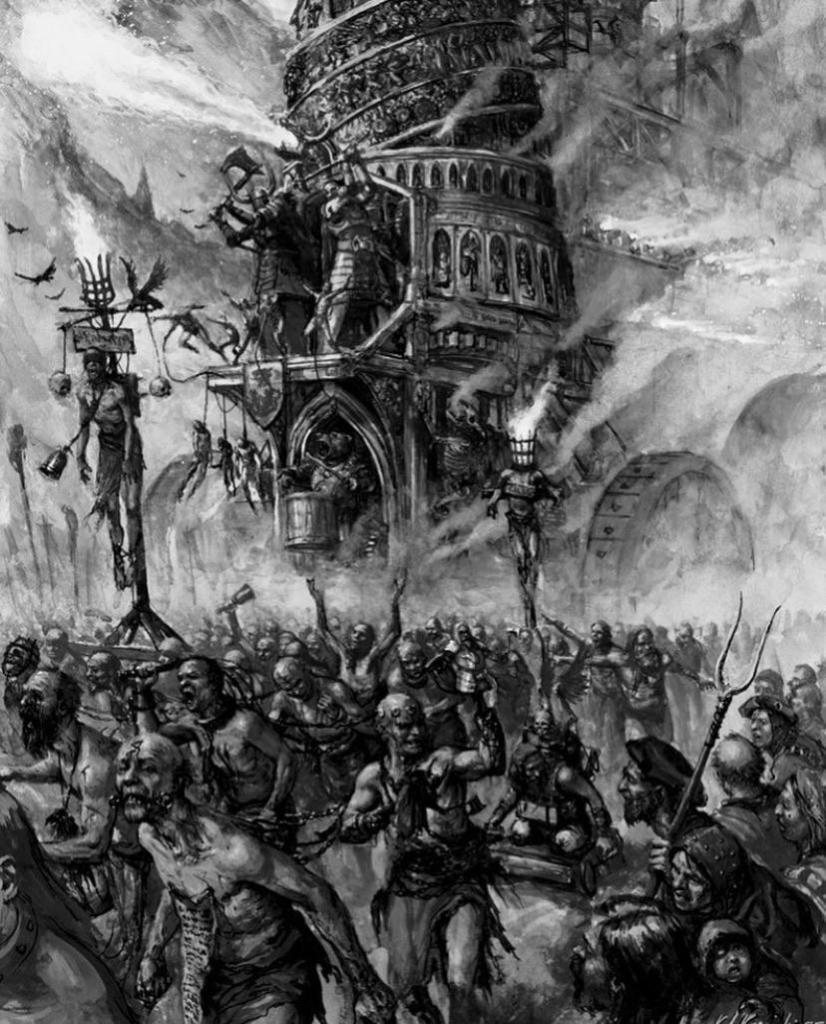
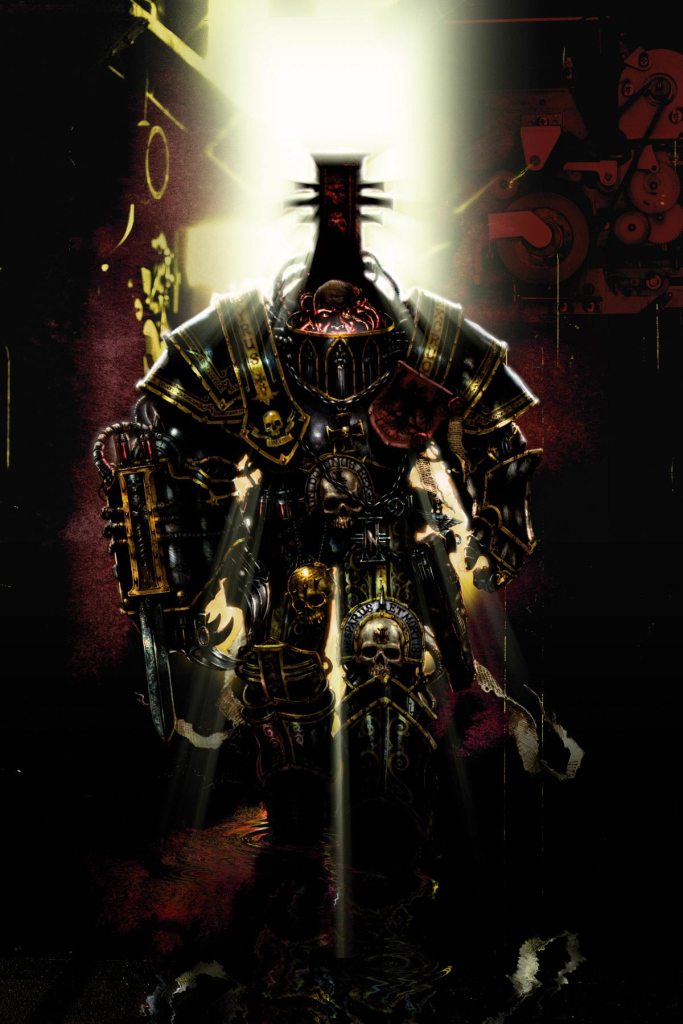
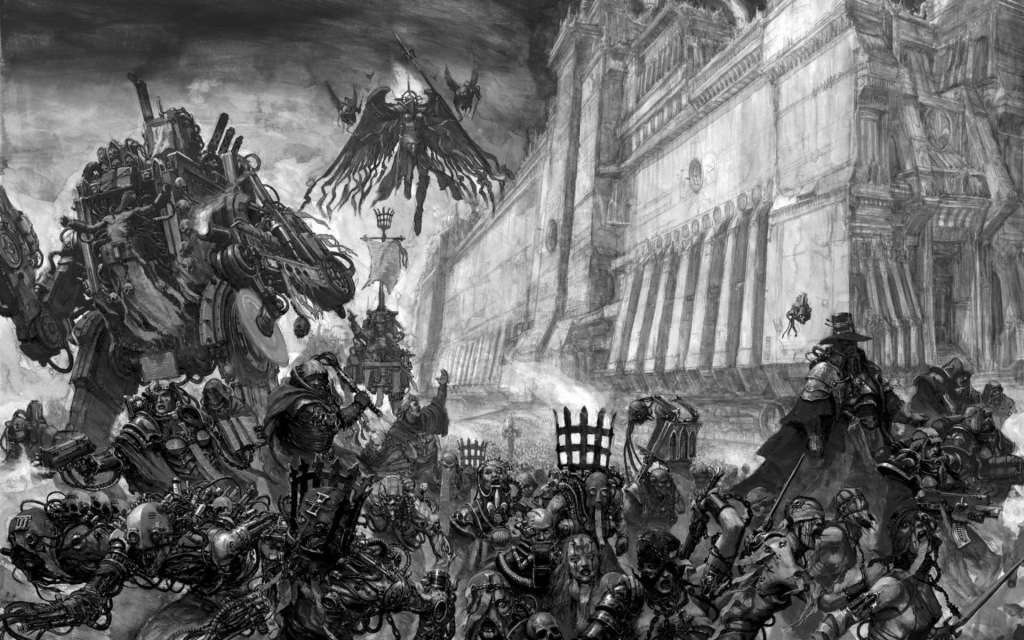
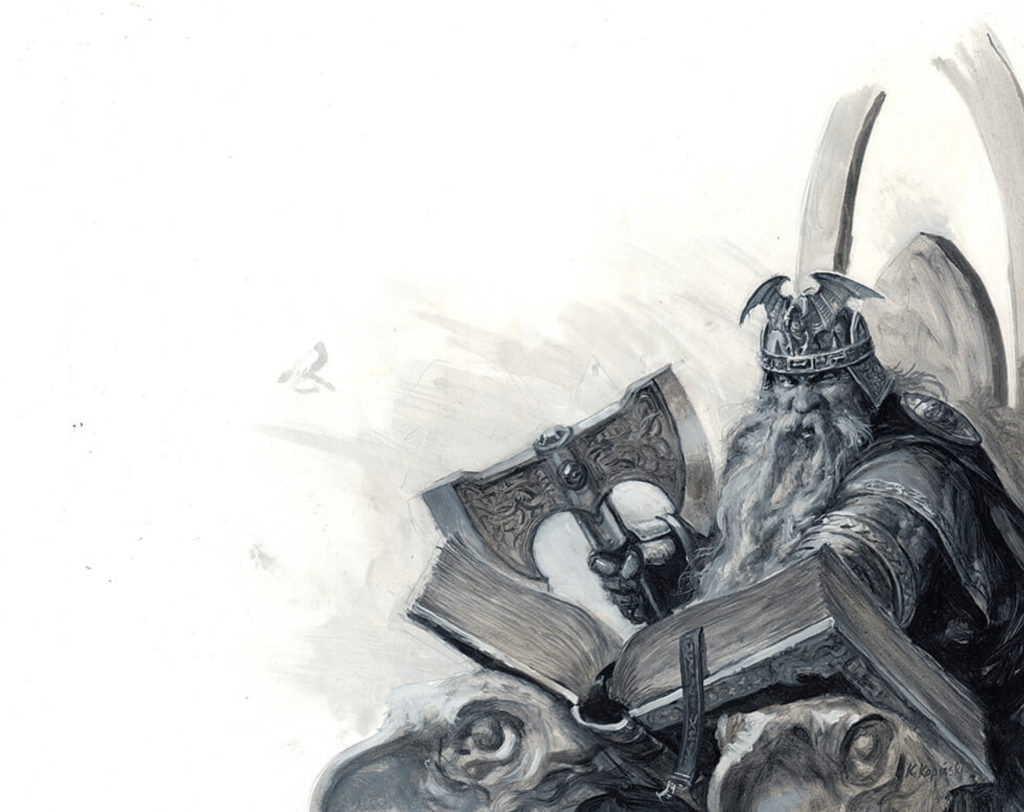
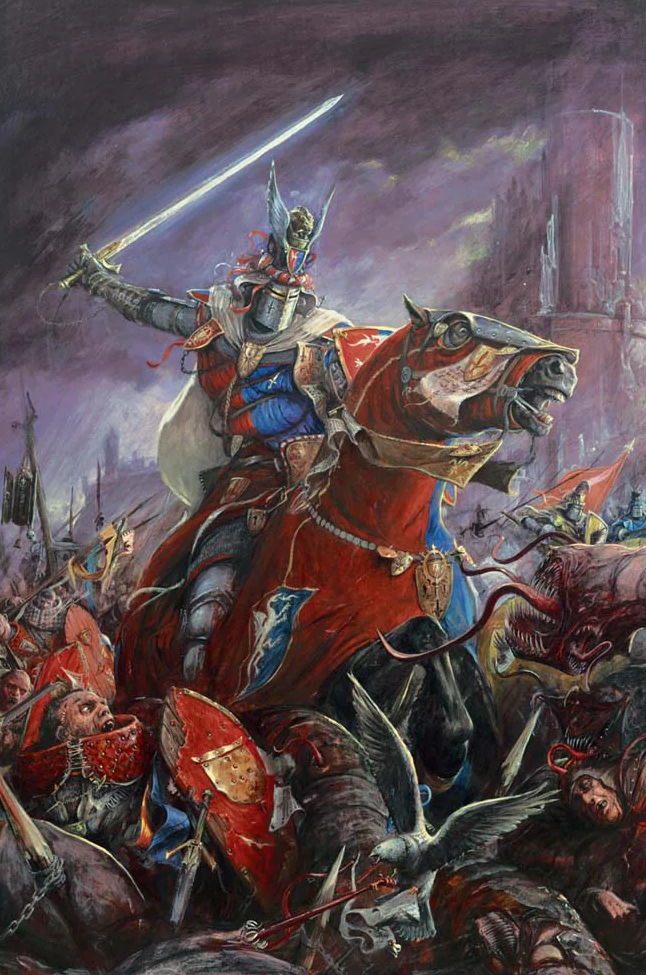
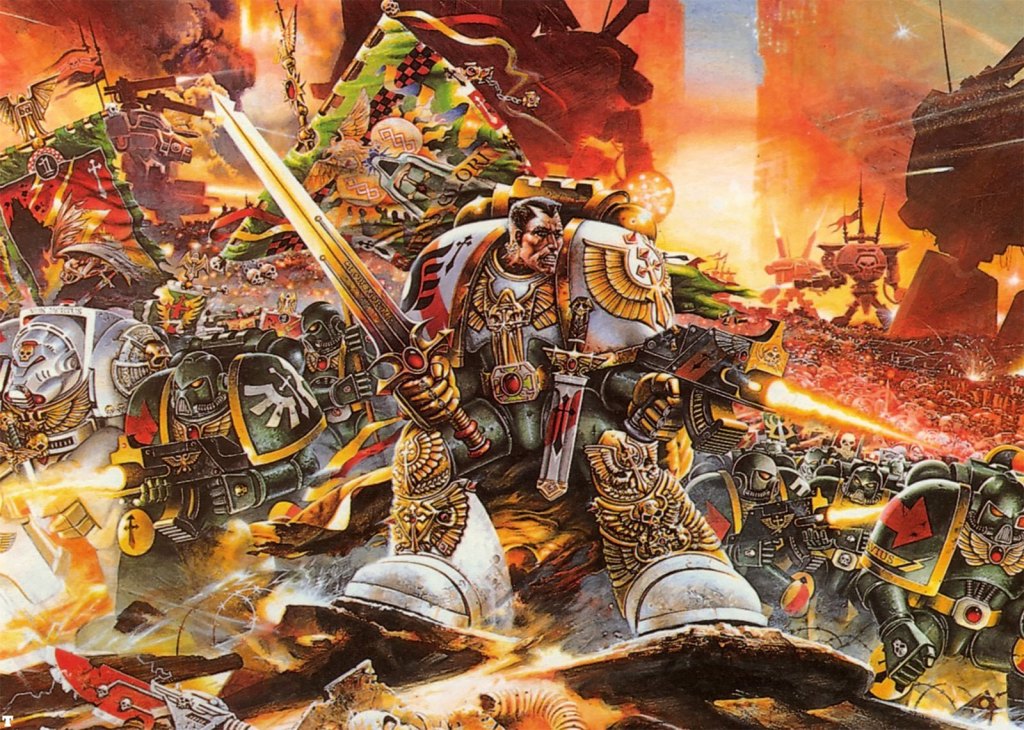
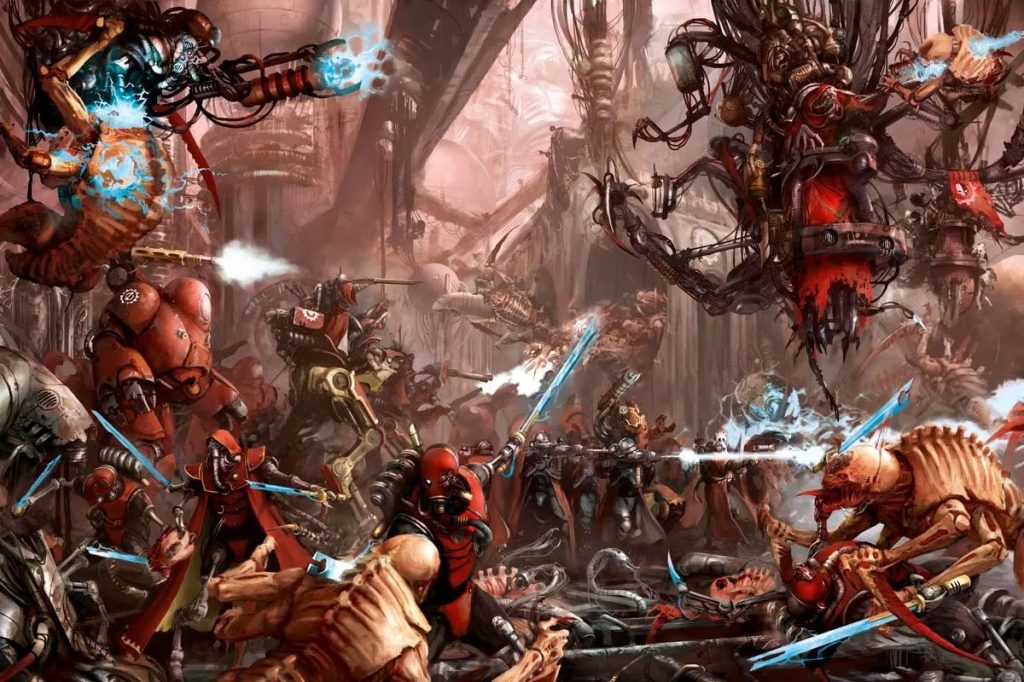
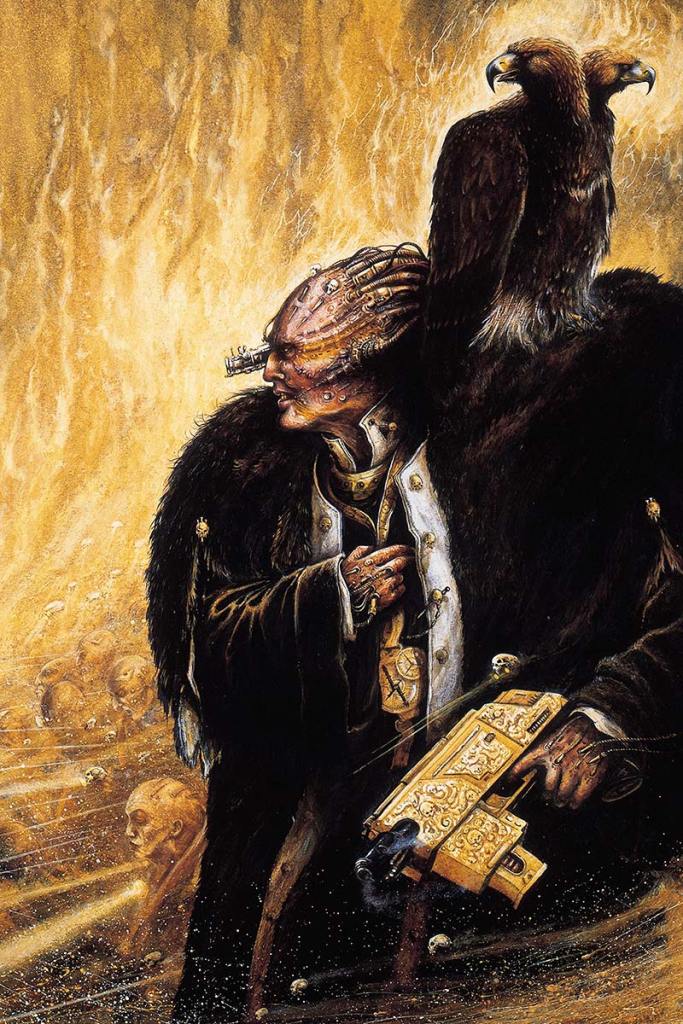
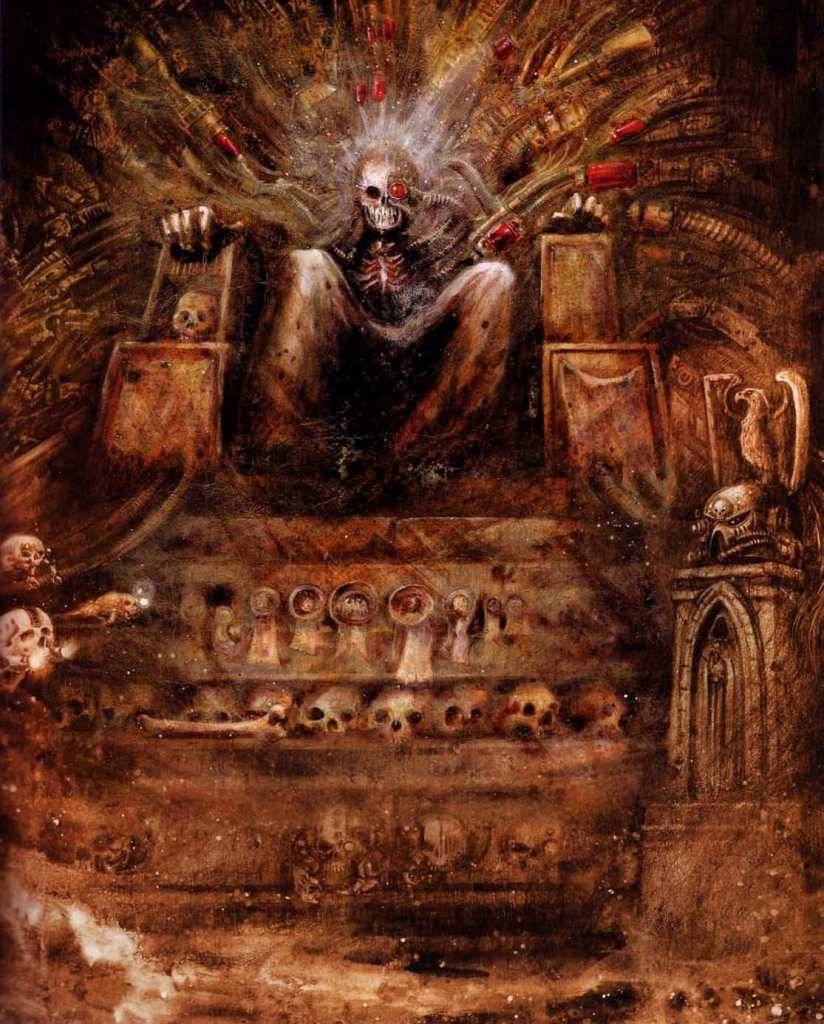
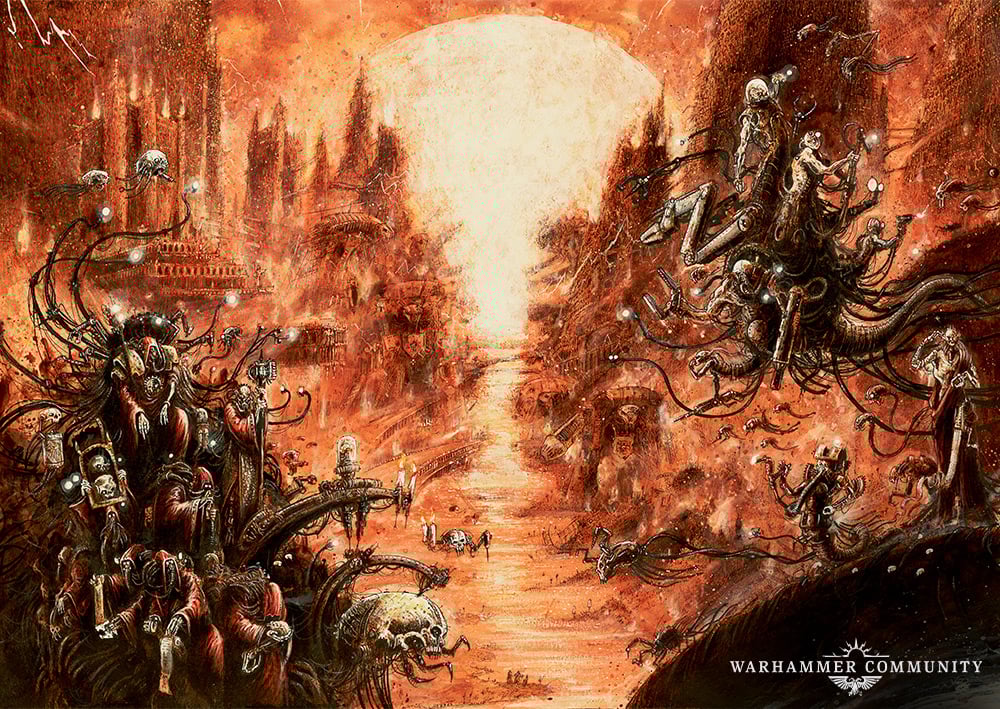
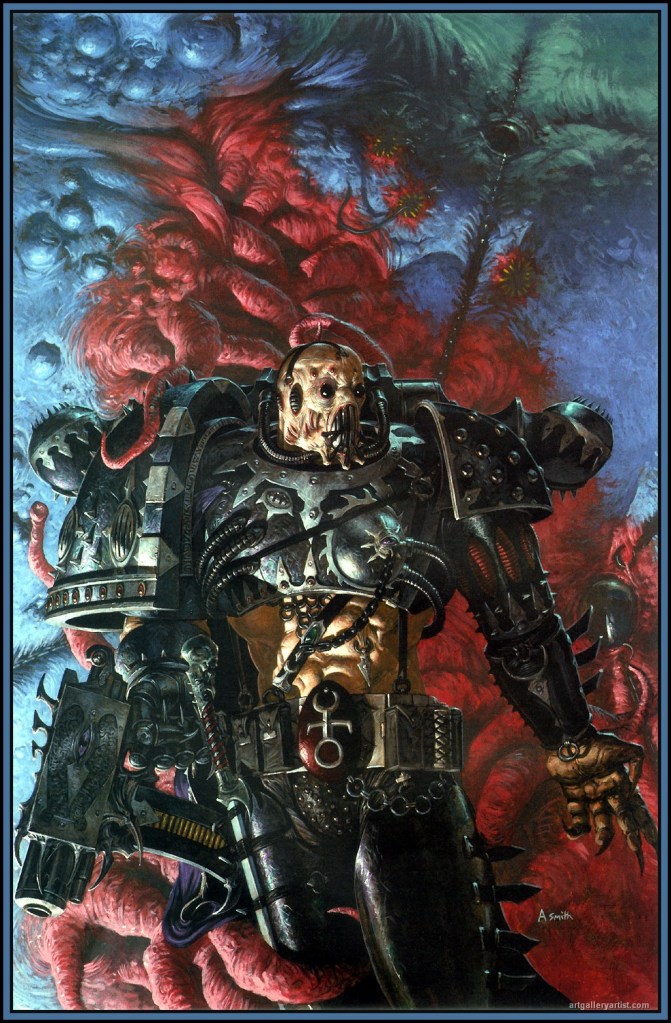
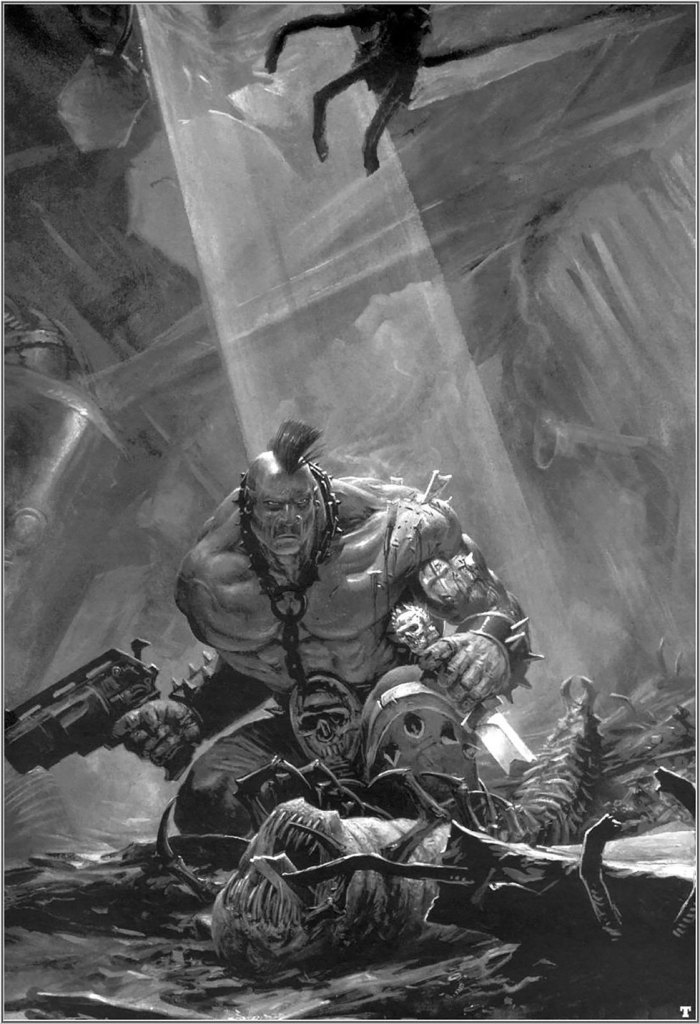
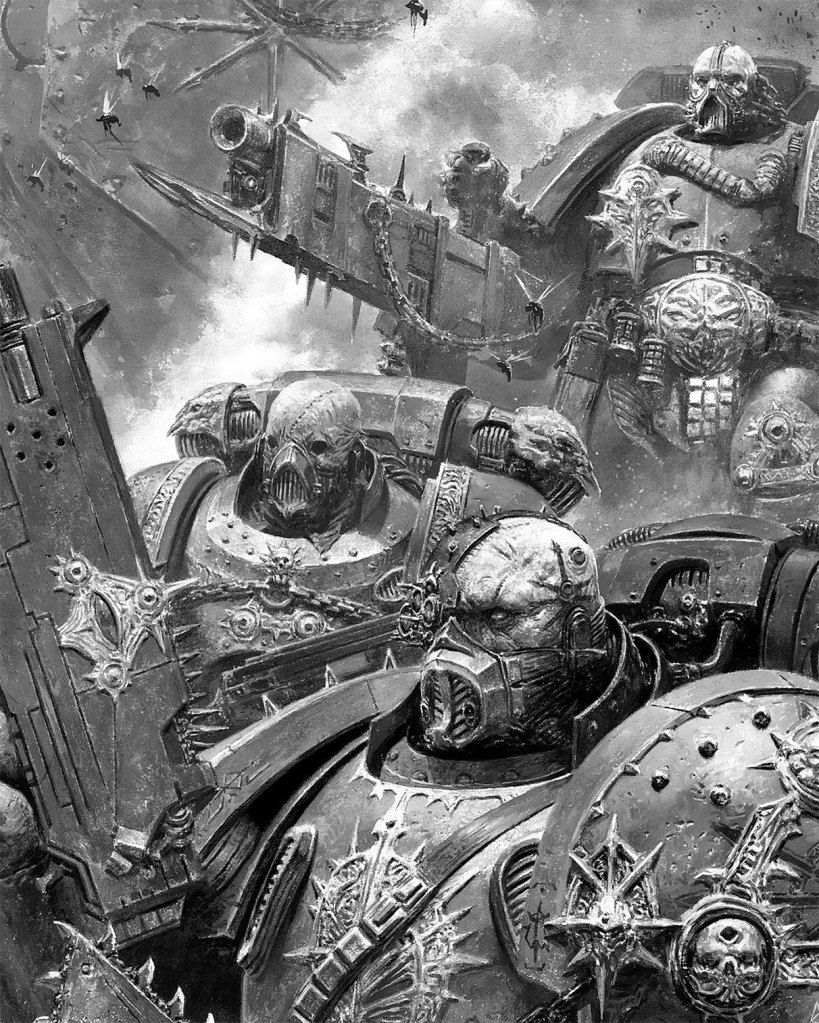
    Two artists from GW talk about the style of Warhammer art, and how it is a mix of genres inspired by some old masters like Bosch or Dürer, followed by jokingly suggesting to look them up. In good White Dwarf fashion it’s a loose conversation with “Alex” and “Paul” – we have to assume it’s Alex Boyd and Paul Dainton. Then you look at the images. Not a single name mentioned in the image captions. You actually see works by Adrian Smith, John Sibbick, John Blanche, Paul Dainton and Alex Boyd. Most hobbyists who have been around since the 80s, 90s or 00s would most likely know, but it can be assumed that a big chunk of the White Dwarf audience is of a younger age and not familiar with the history you are just trying to present.

    Let me be clear: in a 4-page article that is part of a 27-page history lesson on GW, to not even drop a single artist name when showcasing their art is atrocious. John Blanche was 46 (!) years of those 50 employed at GW, in various functions. A very specific group of artists has shaped how Warhammer looks and feels like, which in turn has had ripple effects in the general perception of how fantasy or dark and grim sci-fi can look like. And GW can’t be bothered to even mention one by their full name and give them credit right under their artwork.

    Before anyone gets technical with me about contracts and IP-rights: to contrast this with something else, I opened this week the fresh-off-the-press Trench Crusade rulebook.

    Without a doubt – the artwork in that rule book is absolutely outstanding. It really paints a horribly dark and gloomy picture of the world. Each artwork can be an inspiration by itself for some deranged, cursed kitbash or paintjob.

    You open page 1 – and every single person working on this book is listed, including every single artist who contributed art. With designated initials, that can be found directly on their respective artworks within the book.

    It is kind of ironic that the Trench Crusade rulebook is even dedicated to – John Blanche (among others). Almost as ironic as Army Painter grabbing Blanche as a brand name to release 2 paint sets, with Citadel sleeping on this golden opportunity and still releasing paint in pots in 2025. But I digress.

    I don’t want to rant, even though it does sound like it, but instead end this blog post on a positive note. Art published within the White Dwarf or other GW books has shaped my own imagination, in the same profound way as for example the Lord of the Rings novels did when I read them as a child. This is thanks to the platform Games Workshop gave artists, whose works I love and cherish to this day. And even if GW drops the ball on celebrating this, at least I can share in my little corner art that has altered my brain chemistry.

    Enjoy this personal and curated selection.

    Paul Dainton:

    Karl Kopinski:

    Alex Boyd:

    John Blanche:

    Adrian Smith:

  • Kitbash your own Kamping

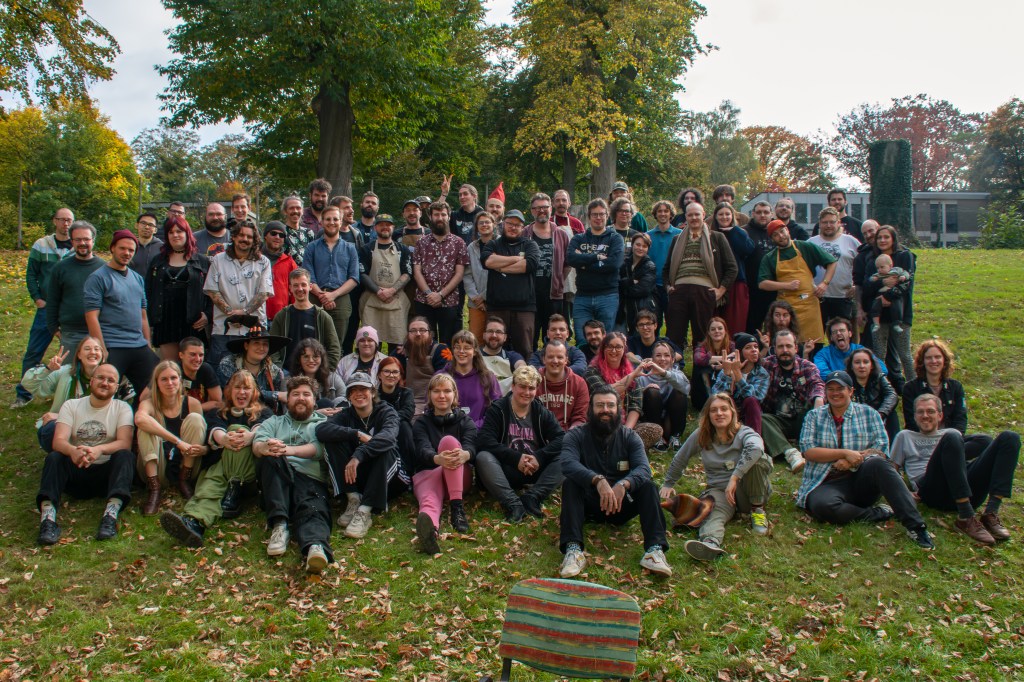
    It’s been already a few weeks, since I attended a very special event in this little hobby niche of ours. In the Belgian town of Leuven, hidden amongst bushes and trees on a hill overseeing the town, a gathering of very excited nerds took place that left a lasting mark on some if not many who attended.

    What is Kamping Kitbash you ask? Probably you don’t, because there has been so many posts both on that cursed photo app or within the blog-sphere, you would have gathered already a pretty clear image in your head what the event entails.

    Nevertheless, let me give you the briefest possible summary, as I want to use this post to rather reflect on the nature of such events, their impact on people attending (and not attending) and the very broad term “community”.

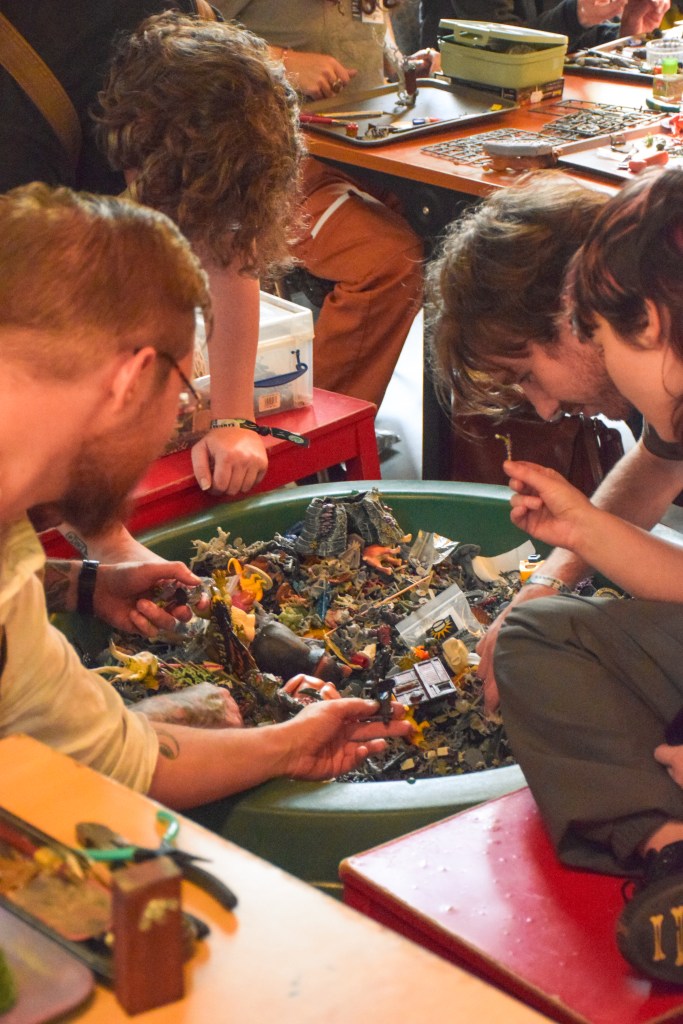
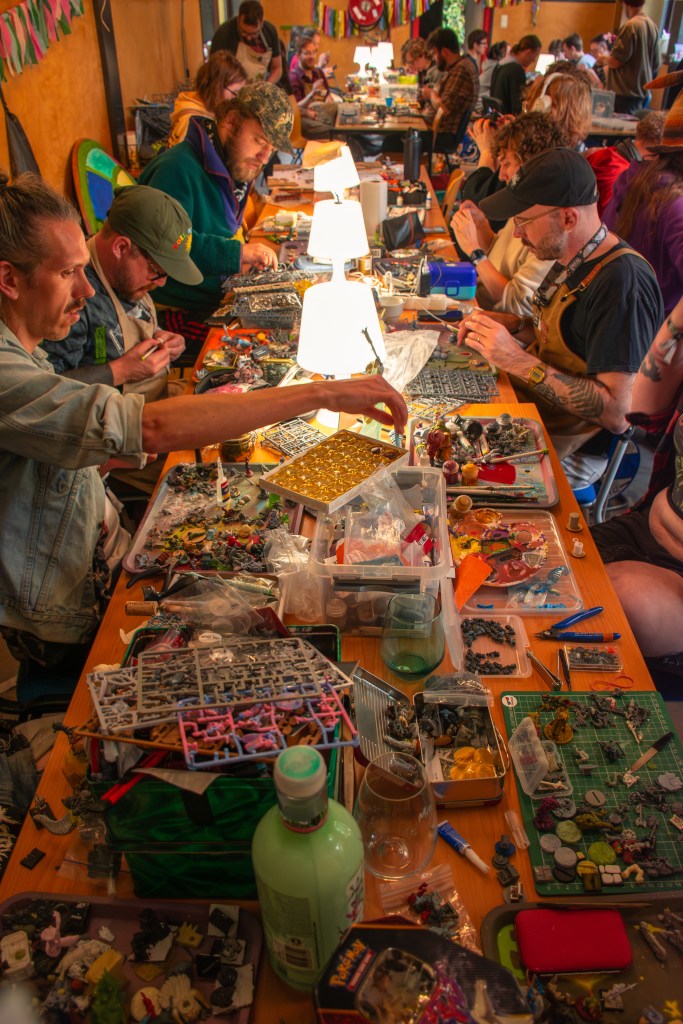
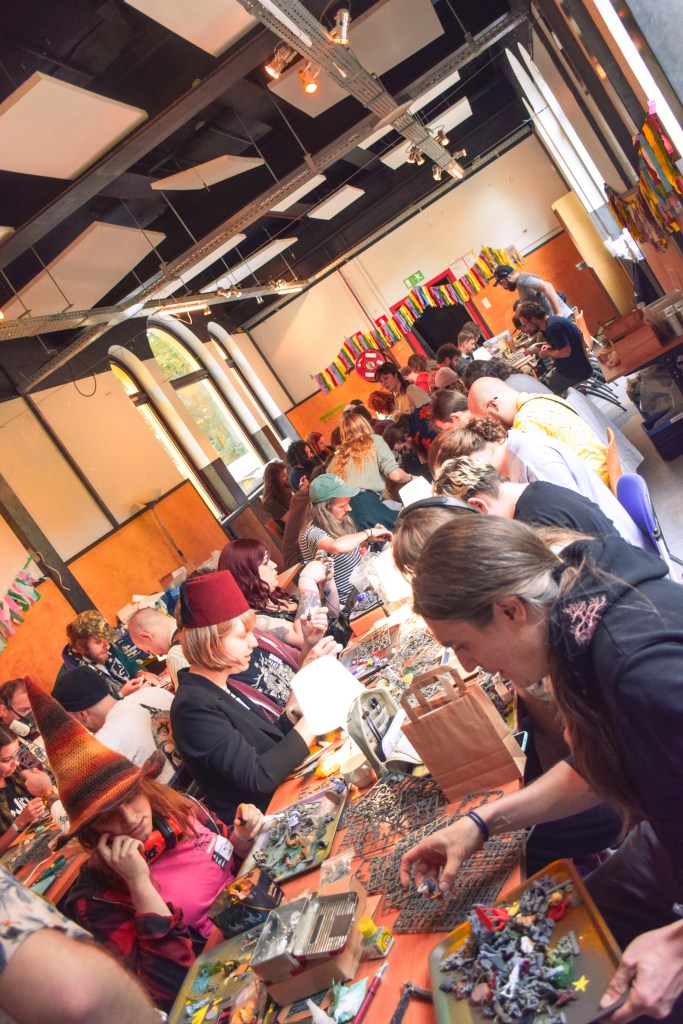
    Kamping Kitbash is – as the name implies – very much focused on the crafty side of the hobby, though it’s not the exclusive topic. But the hallmark of the event has to be a bathtub full of bits, in the middle of a large room, with dozens of people sitting in superglue fumes, merging said bits in the most creative ways. Variations of this activity include pass-along kitbashing and consequently pass-along painting. It’s a relentless exercise that gets even the stalest creative juices flowing.

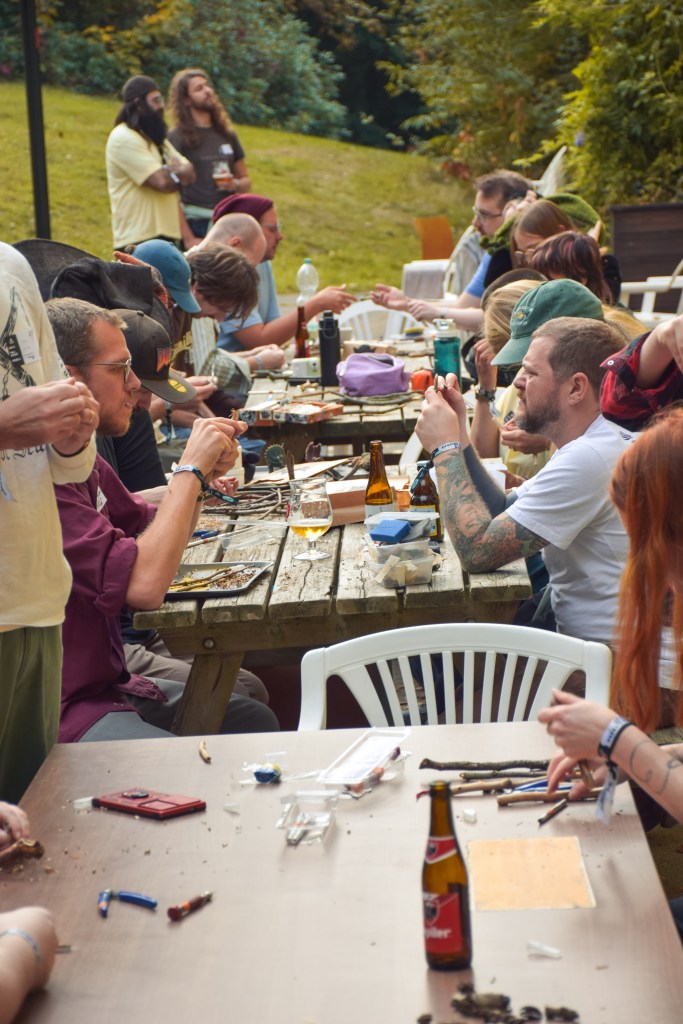
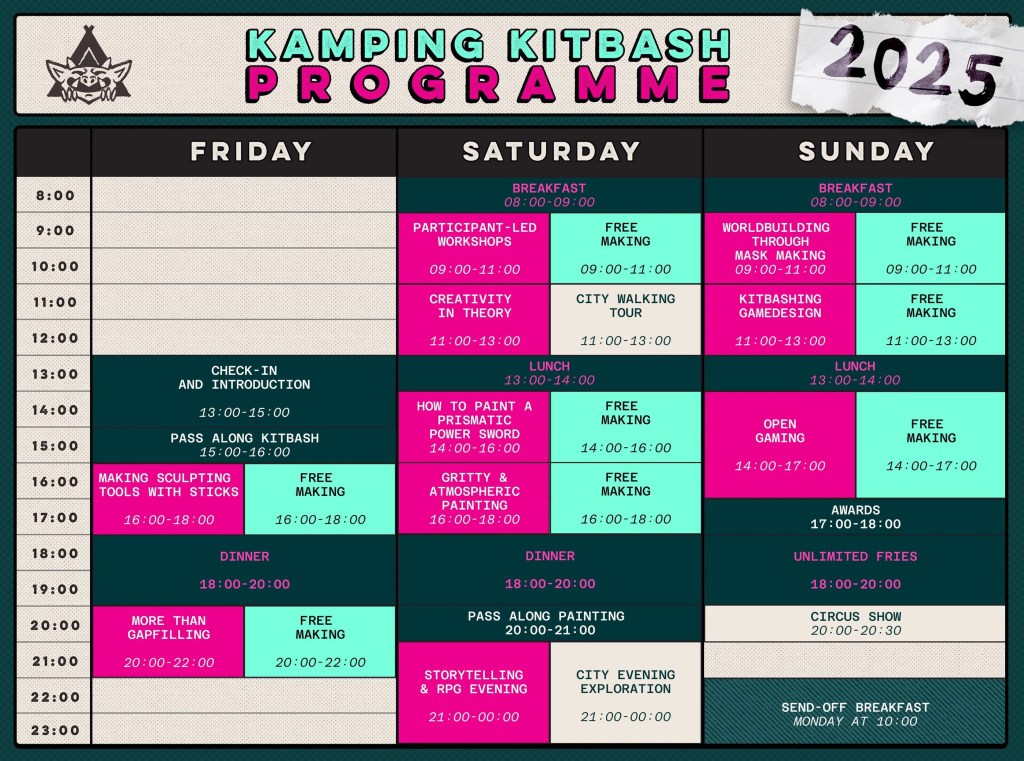
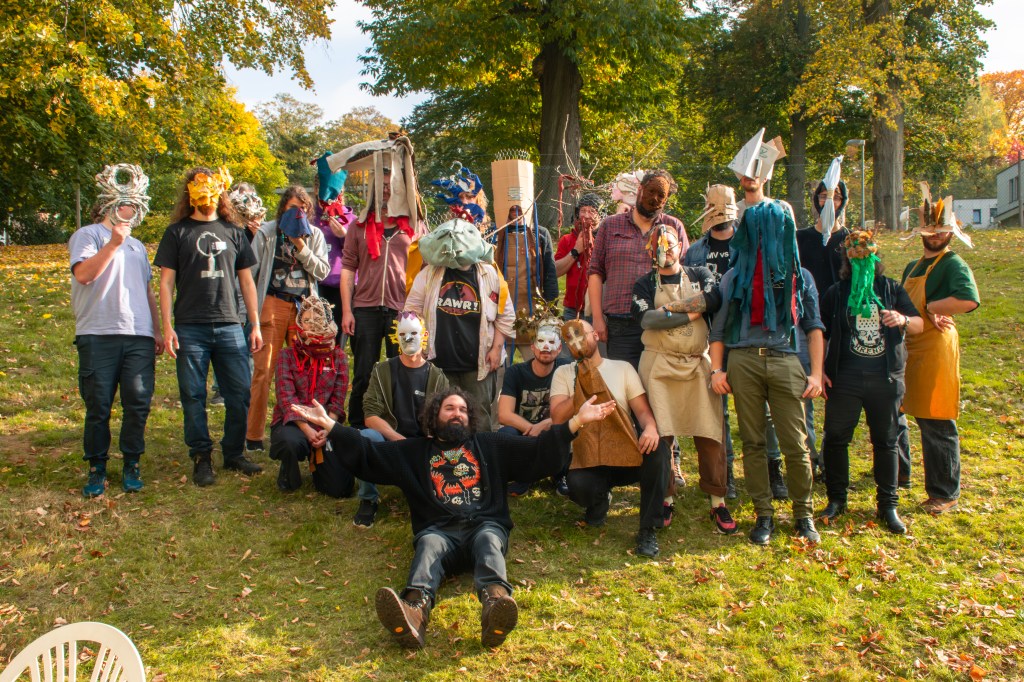
    Now with this latest instalment of the event (and the first one I attended in person) the 3-day-stay at or around the venue was enriched with a plethora of fascinating workshops, of which one could sadly only attend two of their choice. If you have had literally any touchpoint with the creative and artistic side of the hobby, the list of workshops will give a very clear picture, I’ve attached a screenshot. Personally, I was able to attend toolmaking with Terran (@conjuredcraft), who made us touch grass and create crafting tools from natural materials. And my second workshop was World-building through Mask-making, a fascinating experiment hosted by Shane (@7he_blindman). I will follow up on this world-building idea I had during the workshop, one day. In a RPG setting of some sort.

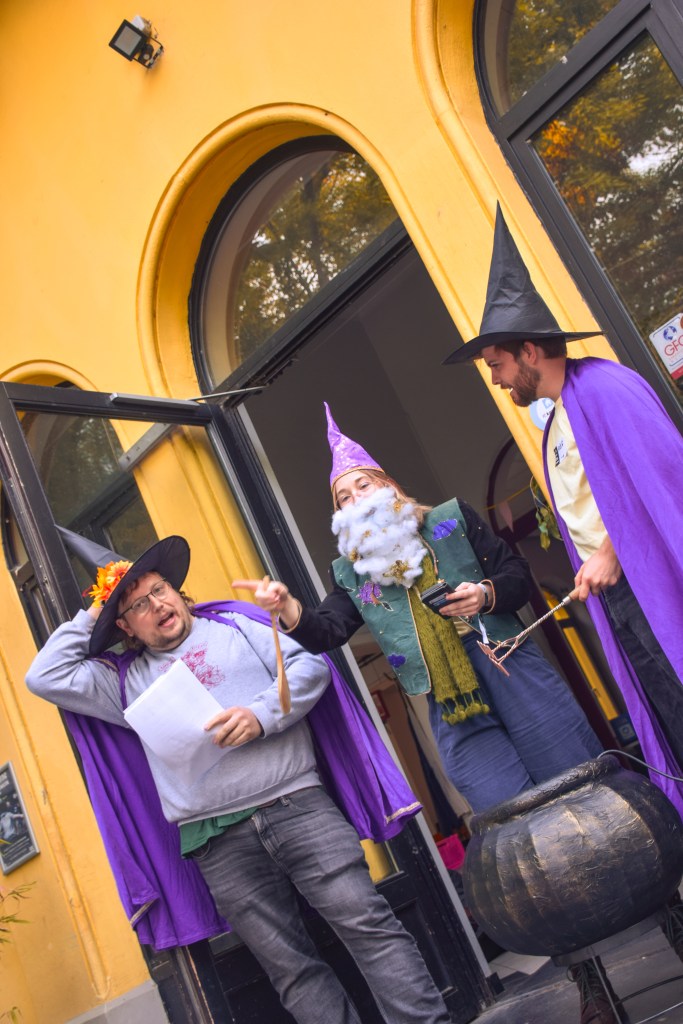
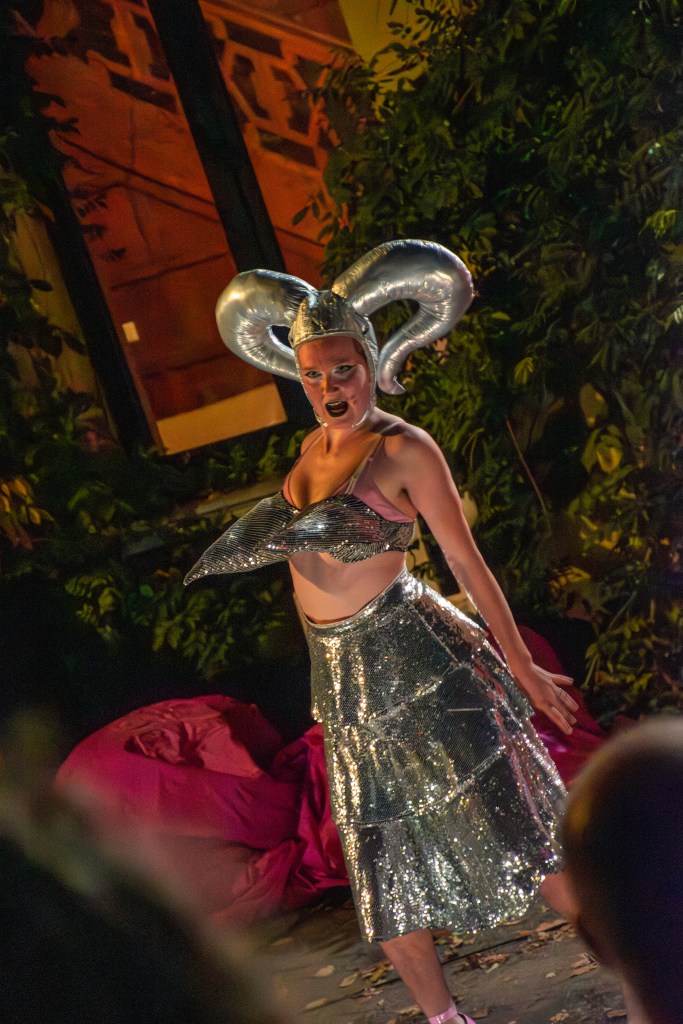
    Outside of the official programme there was plenty of room to also organise some gaming, and you would see every day some impromptu gaming or RPG sessions happening. Framing this were events organised by the Kamping Kitbash team themselves, one was the musical storytelling evening (@jappedelva) and the other was a cozy, clitoris-themed circus show (what a chain of words!) during Sunday night (@sien.vanacker). Absolute highlight.

    Not to mention that there was a whole volunteer team keeping everyone comfortable, well-fed and well-hydrated. Leuven city tours (at night and day) were also included. Attendees had also the chance to sell some of their beautiful wares, and some even gave away stuff for free, in particular Mathilde and Jonathan from @vaevictisminiatures, who gave away hundreds (yes, hundreds) of minis for free over the weekend. Incredible generosity.

    So overall, it was hands down, one of the best events I have ever been to. Even if – or maybe because – it wasn’t so much focused on the gaming aspect of the hobby, but rather the arts and crafts side of it. My feeling was that all KK-attendees were still feeding off of the energy they gathered from this event for weeks, and it was supercharging peoples creative outlets, as some of the blog posts or creative works on various Discord servers show.

    There was definitely a downside to all of this – which leads me directly to my point. Though, downside might be a strong word. Before and after the event I heard from / read about people unable to attend voicing their fear of missing out, or FOMO as my fellow kids use to say. Insert Steve Buscemi meme here.

    Now, is this justified? To feel like one has missed out? Yes. And no.

    Of course, the level of professionalism, diversity, inclusion, organisation, size and even routine of Kamping Kitbash is a sight to behold and an experience to remember. No doubt about it. But also, when you ask the organisers (shout-out to @666_crafts @mesreg @tine_fielding @hippoliet_) how it all started, they will tell you that the ball got rolling with the simple wish to “hang out with all my friends and do hobby stuff.” Simple as that. And now, just a few years later it has reached 70+ attendees and is being visited by people from all over Europe and even the US. Tickets are selling out within minutes.

    What I am trying to say, and frankly so many of the lovely humans attending KK this year have repeated this: don’t feel FOMO for something that you can start right now, right there, where you are sitting. The start of your own local community is just one simple, small event away.

    Need inspiration? You can start by checking out the goals and event bible of Kamping Kitbash.

    Do you want to have a craft focused event? Gather a few of your friends, throw some sprues and bits onto the kitchen table and bash away, with some good drinks and good music – done.

    Do you want to have a wargaming event? Pick one of your favorite games, and become its ambassador in your local area. Create 2-3 warbands for it, and invite people to play.

    Do you want to host workshops? Go for it. In your local area there are certainly people who can share knowledge and experience they have. From my personal, local community I can attest that we have people who have already been teaching non-metallic-metal painting, or digital kitbashing with Blender.

    If your local scene already has a room that is being used for hobby events, like game nights, even better! Because people organising events will confirm that finding the venue is always the hardest challenge – once that is set, everything else will most likely follow.

    Also, expectations are not high, if you invite your friends at first. No one expects a cozy, clitoris-themed circus show, if you know what I mean (yes, and it is also an excuse for me to write that string of words a second time).

    Who knows, what it might snowball into? And if it doesn’t, it’s also fine, because all you need to experience that special Kamping Kitbash feeling is a pile of bits, a few good friends, and maybe a snack. You have re-created for yourself 90% of the fun that was had at that special event in Belgium.

    Go kitbash your own kamping.

    (all photos courtesy of the very talented Daan @mesreg)

  • What the hell is this?

    Oh no, another blog! – Yes, another one. Or maybe something else, I don’t know yet.

    Simply put: In the age of soulless AI-slop driven by corporate algorithms, seeing cool stuff made by real humans and reading their stories about their process is the real reward.

    It probably also explains why blogs are seeing a revival, as this seems to be a universal feeling of people being tired of platforms that – while calling themselves social – limit social interaction to an absolute minimum.

    So, this little corner of the internet will be my space to share a journal of my hobby, more in-depth than superficial photo posts would ever allow. If you want to read about tabletop gaming, miniature painting and sculpting, RPGs I play, events and concerts I visit or new music I discover and love – or really any type of nerd shit, feel free to follow. Or just add the RSS feed to the app of your choice. Cheers.

    Mato